


Dynastic History | Great Zimbabwe, the Great Enclosure — Dry Stone, and the State That Policed Who Built It
· 1350
Unreviewed contributionBy kevin · · updated · Report an issue






















































Find memories left by people near you.
Distribute Bounty
This will distribute the bounty equally among all qualifying memories. This action cannot be undone.
Cancel Bounty
Are you sure you want to cancel this bounty? The remaining amount will be refunded to your account.
Success!
Operation completed successfully.
Error
Something went wrong.
Dynastic History | Great Zimbabwe, the Great Enclosure — Dry Stone, and the State That Policed Who Built It
kevin
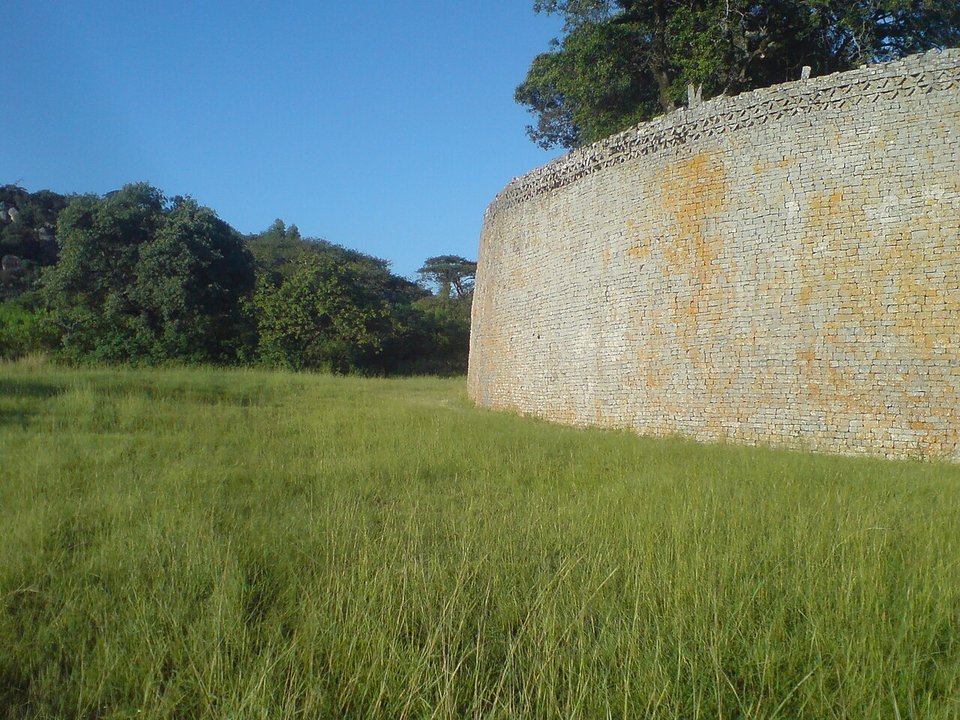
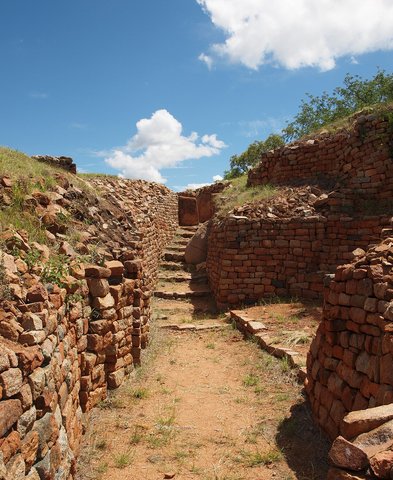
The wall is laid dry: dressed granite blocks stacked without mortar, curving for hundreds of metres and finished along the top of its eastern arc with a band of chevron. Dzimba dza mabwe, houses of stone, is the Shona phrase behind the country's name. UNESCO places the Great Enclosure's main building phase in the fourteenth century, inside an occupation the radiocarbon series puts between the twelfth and the fifteenth; other published accounts date its completion nearer 1450.
Nobody here wrote the project down. The state that commissioned this wall left no chancery and no annals, and the earliest written notice of the place comes from outside it — in 1531 the Portuguese captain Vicente Pegado recorded that the local word for such buildings meant "court". So the labour that quarried, dressed and carried the granite has to be read out of the ground rather than off a page, alongside the cattle the economy ran on, the gold and ivory that went down to the coast, and the Chinese porcelain and southeast Asian beads that came back.
That silence was filled by other people. Karl Mauch, arriving in 1871, assigned the work to Solomon and Sheba. Theodore Bent dug into the conical tower in 1891 under Cecil Rhodes's patronage and destroyed the stratigraphy. Richard Nicklin Hall, made curator after the 1902 Ancient Monuments Protection Ordinance, stripped three to five feet of deposit off the site as later debris and was dismissed for it. David Randall-MacIver in 1905 and Gertrude Caton-Thompson in 1929 both concluded the builders were African, and the Rhodesian state spent the 1960s and 1970s requiring guidebooks, museum displays and school texts to say otherwise. Peter Garlake, its inspector of monuments from 1964, left the country in 1970.
The enclosure is on the visitor route of a national monument run by the National Museums and Monuments of Zimbabwe, inscribed by UNESCO in 1986.
📸 Cover: The outer wall of the Great Enclosure with its chevron course, Jens Klinzing, CC BY 3.0 via Wikimedia Commons


changes?
delete this memory?
We detected that you have a Blox in your crypto wallet! We will import the Blox into your account.
Click on done below to complete the import.
Welcome Back!
Sign in to preserve cherished moments
Don't have an account?
Welcome!!
Sign up and start preserving cherished moments
?
?






Choose your payment method
Buy with Metablox Credit
Do you want to mint Blox with Metablox Credit?
Which Crypto would you like to use?
Purchase Confirmed!
Your Blox is being minted on-chain and will appear in your profile shortly.
Log in or sign up to claim your Blox.
How many credits do you want to buy?
$100 USD = 1 Metablox Credit = 1 Blox.
Use Metablox Credit to mint any Blox you want on the map.
 expand_more