Technology History | Peenemünde — More People Died Building It Than It Killed
volume_up
Listen
directions
Directions
On 3 October 1942 an A-4 rocket left a test stand on this island, climbed to about 84.5 kilometres, and came down in the Baltic.
It is routinely described as the first man-made object to reach space, and that needs a boundary drawn before it means anything.
84.5 kilometres is above the eighty-kilometre line the United States uses and below the hundred-kilometre line the international body uses, so the claim is true under one definition and false under the other.
What is not in dispute is that nothing built by people had been that high before, and that the machine was a weapon.
The Army Research Centre at Peenemünde had been developing rockets here since the late 1930s, under Walter Dornberger with Wernher von Braun as technical director.
Its A-4 became the V-2, short for Vergeltungswaffe 2, a vengeance weapon aimed at cities.
The RAF bombed Peenemünde on the night of 17 August 1943 in Operation Hydra, and production moved underground to the Mittelwerk, a tunnel complex in the Kohnstein near Nordhausen.
That is where the part of this history that matters most happened, and it happened four hundred kilometres from here.
The Mittelwerk was worked by prisoners from the Mittelbau-Dora concentration camp, more than sixty thousand of whom passed through it.
They lived underground for the first months, on starvation rations, under guards who executed people routinely, and roughly twenty thousand of them died.
They built about six thousand rockets between August 1943 and April 1945.
More people died making the V-2 than were killed by it.
Von Braun was aware of the labour and became more involved as production scaled; Dornberger, the SS general Hans Kammler and the factory engineer Arthur Rudolph drove the decision to use camp prisoners.
Most of the engineers surrendered to the United States in 1945 and were taken to America under Operation Paperclip; most of the surviving Dora prisoners were sent on death marches.
The site is now the Historisch-Technisches Museum Peenemünde, in the shell of the power station that supplied the research centre.
It does not present the rockets as an achievement with an unfortunate footnote, which is the right decision and an unusual one.
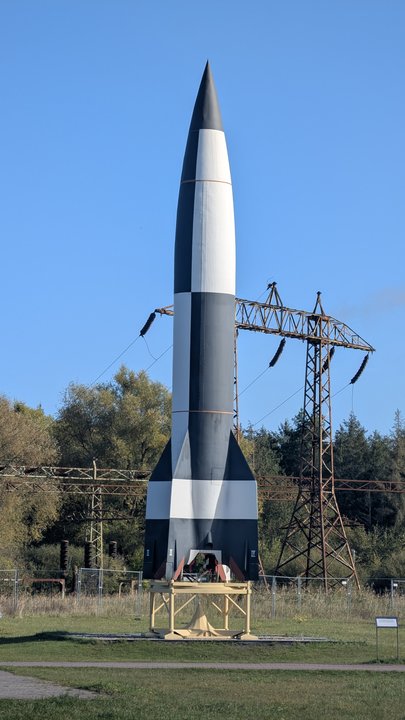
Photo: a full-scale A-4 replica standing outside the museum, painted in the black-and-white roll pattern used on test vehicles to measure spin — operational rockets were camouflaged, not striped like this.
Sources: English Wikipedia on the 3 October 1942 launch and on Mittelwerk; the University of Alabama in Huntsville's Dora archive; White Sands Missile Range Museum.
Photo: Siarhei Besarab, CC BY-SA 4.0, via Wikimedia Commons.
































































 expand_more