- Home
- Technology History | Computers People Could Actually Use | Business Machines, Timesharing and the First Personal Computers
- Technology History | Cadby Hall, Hammersmith — The Plaque Says November, the Machine Ran in September
Technology History | Cadby Hall, Hammersmith — The Plaque Says November, the Machine Ran in September
· 1951-9
Personal memoryBy kevin · · updated · Report an issue
Find memories left by people near you.
Distribute Bounty
This will distribute the bounty equally among all qualifying memories. This action cannot be undone.
Cancel Bounty
Are you sure you want to cancel this bounty? The remaining amount will be refunded to your account.
Success!
Operation completed successfully.
Error
Something went wrong.
Technology History | Cadby Hall, Hammersmith — The Plaque Says November, the Machine Ran in September


kevin
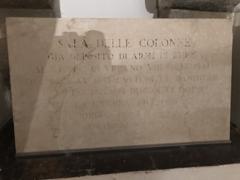
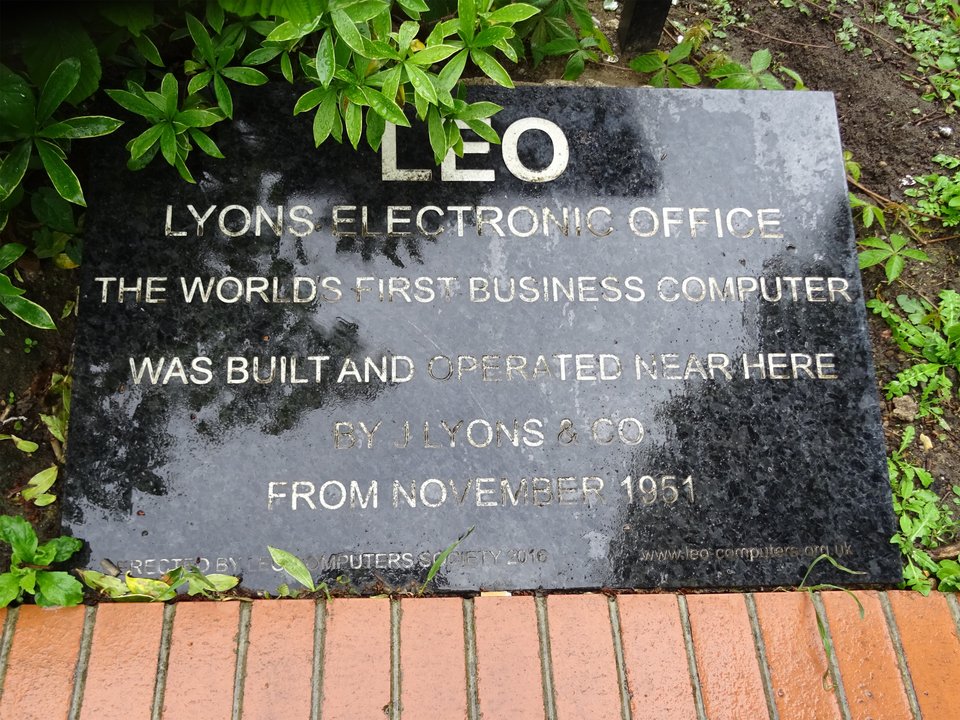
The plaque is set flat into the ground beside a Hammersmith walkway, and it says November 1951.
The machine had already run the job in September.
LEO, the Lyons Electronic Office, completed a program called Bakery Valuations on 5 September 1951, working out the cost of ingredients going into the bread and cakes made at the J. Lyons factory at Cadby Hall.
It took the job over permanently on 29 and 30 November, which is the month the plaque commemorates.
A third date, 17 November, circulates widely and the record does not support it.
The stranger part is whose machine this was.
J. Lyons & Co. sold tea, ran teashops and baked cakes, and built its own computer to do its own paperwork.
Two Lyons managers had gone to the United States in 1947 to study wartime office methods, and came back pointing at Cambridge instead of anywhere American.
The company backed a machine modelled on Maurice Wilkes's EDSAC, built at Cadby Hall under the engineer John Pinkerton, with Derek Hemy writing the programs.
Its mercury delay lines held 2,048 words of thirty-five bits, four times EDSAC's memory, because office work means moving a great deal of data rather than doing difficult arithmetic.
Pinkerton gave it multiple input and output buffers for the same reason, which is the design decision that separates a business computer from a scientific one.
In February 1951, before any of this, the machine ran a test program for Princess Elizabeth.
Lyons later sold computers to Ford, Kodak and others through a subsidiary, which is how a catering company spent a decade as a British computer manufacturer.
The plaque's larger claim deserves the same care as its date.
Calling LEO the world's first business computer holds up if you mean the first built and used for routine commercial office work — which is the meaningful sense, and worth stating as a qualifier rather than a slogan.
Cadby Hall is gone, demolished in 1983, with offices standing on the site.
That is why the LEO Computers Society laid this marker in 2016 on Lyons Walk instead of fixing it to a factory wall, and why the wording is "near here" rather than here.
Photo: the 2016 marker, photographed in 2021. The factory it commemorates was already thirty-eight years demolished.
Sources: English Wikipedia's LEO article and the Science Museum, London; Modern Records Centre, University of Warwick; IEEE ETHW milestone proposal.
Photo: Spudgun67, CC BY-SA 4.0, via Wikimedia Commons.
changes?
delete this memory?
We detected that you have a Blox in your crypto wallet! We will import the Blox into your account.
Click on done below to complete the import.
Welcome Back!
Sign in to preserve cherished moments
Don't have an account?
Welcome!!
Sign up and start preserving cherished moments
?
?
Choose your payment method
Buy with Metablox Credit
Do you want to mint Blox with Metablox Credit?
Which Crypto would you like to use?
Purchase Confirmed!
Your Blox is being minted on-chain and will appear in your profile shortly.
Log in or sign up to claim your Blox.
How many credits do you want to buy?
$100 USD = 1 Metablox Credit = 1 Blox.
Use Metablox Credit to mint any Blox you want on the map.
expand_more