
- Home
- Semiconductor History | The Bell Era | New Jersey and New York
- Semiconductor History | Murray Hill, 16 December 1947 — Two Physicists, a Razor Blade, and a Signal That Grew
Semiconductor History | Murray Hill, 16 December 1947 — Two Physicists, a Razor Blade, and a Signal That Grew
· 1947-12
Personal memoryBy kevin · · updated · Report an issue
Find memories left by people near you.
Distribute Bounty
This will distribute the bounty equally among all qualifying memories. This action cannot be undone.
Cancel Bounty
Are you sure you want to cancel this bounty? The remaining amount will be refunded to your account.
Success!
Operation completed successfully.
Error
Something went wrong.
Semiconductor History | Murray Hill, 16 December 1947 — Two Physicists, a Razor Blade, and a Signal That Grew
kevin
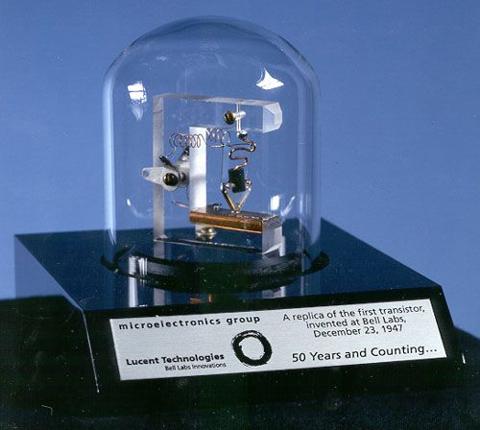
The working part was a triangle of plastic with gold foil wrapped over its point, cut down the vertex with a razor blade.
That cut left two gold contacts a paper's thickness apart, and a spring pressed them onto a slab of high-purity germanium.
On the afternoon of Tuesday 16 December 1947, John Bardeen and Walter Brattain pushed a signal in through one contact and got a bigger one out of the other, with a gain of roughly a hundred and a response that reached into the audio range.
Credit for what happened next has to be handled carefully, because the record splits it finely and this collection's readers know it.
Bardeen and Brattain built the point-contact device. William Shockley led the group, was not in the room that afternoon, and is not on the point-contact patent.
Shockley answered within weeks with a different idea, the junction transistor, and that is the design that could eventually be manufactured in quantity.
Both halves are true, which is why the famous 1948 publicity photograph is worth looking at twice: it seats Shockley at the microscope with the other two standing behind him, and it records a company's preference rather than a December afternoon.
The three shared the 1956 Nobel Prize in Physics.
Julius Lilienfeld had patented field-effect concepts in the 1920s and 1930s, and Bell's patent lawyers knew those filings well. What nobody had before 1947 was a device that worked.
Bell Labs itself long used 23 December as the birthday, the day the demonstration was repeated for senior management. Either date is defensible as long as you say which one you mean.
The site is still a working laboratory, and there is no public tour.
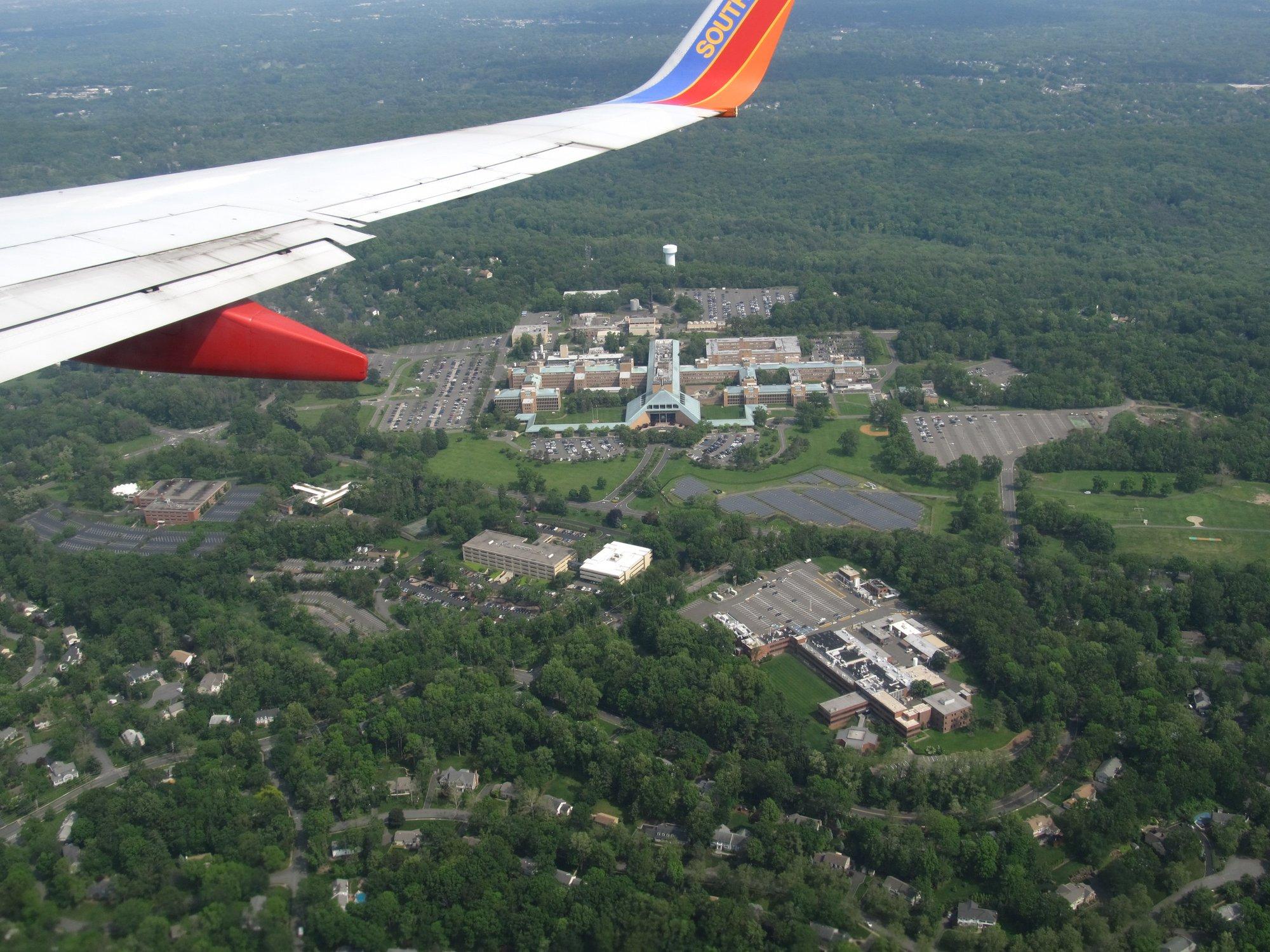
The postal address reads Murray Hill, but 600 Mountain Avenue sits inside the borough of New Providence, and the campus has carried the Nokia Bell Labs name since 2016, after AT&T, Lucent and Alcatel-Lucent before it.


From the road a visitor sees a long, low research complex set well back in woodland, which is what the aerial photograph here shows.
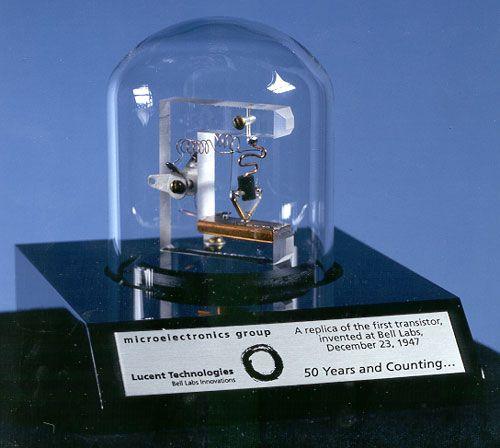
The device is easier to find than the room. Lucent built replicas of the 1947 assembly for the fiftieth anniversary in 1997, and it is one of those, not the original, in the first photograph.
Photo: Federal employee, public domain, via Wikimedia Commons (1997 replica of the point-contact transistor).
Photo: Ken Lund, CC BY-SA 2.0, via Wikimedia Commons (Bell Labs campus from the air, New Providence).
changes?
delete this memory?
We detected that you have a Blox in your crypto wallet! We will import the Blox into your account.
Click on done below to complete the import.
Welcome Back!
Sign in to preserve cherished moments
Don't have an account?
Welcome!!
Sign up and start preserving cherished moments
?
?
Choose your payment method
Buy with Metablox Credit
Do you want to mint Blox with Metablox Credit?
Which Crypto would you like to use?
Purchase Confirmed!
Your Blox is being minted on-chain and will appear in your profile shortly.
Log in or sign up to claim your Blox.
How many credits do you want to buy?
$100 USD = 1 Metablox Credit = 1 Blox.
Use Metablox Credit to mint any Blox you want on the map.
expand_more