Tennis History | Royal Courts of Justice, London — a judge declined, and the players emptied a major, June 1973
volume_up
Listen
directions
Directions
The 1973 boycott is usually told as the players against Wimbledon. The All England Club was not the defendant, and the ruling that led to the empty men's draw was handed down here, on the Strand.
In May 1973 the Yugoslav tennis association suspended Nikola Pilić for nine months over a Davis Cup tie against New Zealand that he did not play.
Why he did not play is still contested. The association said he refused; Pilić said he had never agreed to appear; other accounts have him choosing a World Championship Tennis event in Las Vegas instead.
The International Lawn Tennis Federation reviewed the penalty and cut it to one month from 1 June. That let him into Roland-Garros, where he reached the final and lost to Ilie Năstase, and it kept him out of Wimbledon.
The Association of Tennis Professionals was nine months old, formed during the 1972 US Open. It said that if Pilić could not enter, its members would not enter either.
The ATP and Pilić then applied to the British High Court, sitting here, for an injunction lifting the ban.
Sir Hugh Forbes refused it. He ruled that there had been "no breach of natural justice", declined to reinstate Pilić, and ordered him to pay all costs, which Sports Illustrated estimated a fortnight later at $11,000.
The finding is the part worth sitting with. A national court was asked whether a private federation could shut a player out of a tournament, answered that it could, and made him pay for asking.
The players did not appeal. They did the one thing no injunction could reach, which was to stay away.
The championships opened on 25 June without eighty-one ATP members, the defending champion Stan Smith among them. Accounts differ on how many of the sixteen men's seeds went, twelve by one count and thirteen by another.
Three ATP members entered anyway: Năstase, Roger Taylor and Ray Keldie. Their own association fined all three, and Năstase said the Romanian government and army had ordered him to play, and lost his appeal.
Jan Kodeš won the men's title. The women's event was untouched, the ATP being a men's body, and Billie Jean King beat Chris Evert 6-0, 7-5 in the same weeks that a separate meeting of women players in London founded the Women's Tennis Association.
Attendance reached 300,172, the second highest to that date, which is the number the federations kept. The players kept a different one: a body nine months old had emptied the men's half of one of the four majors and survived doing it.
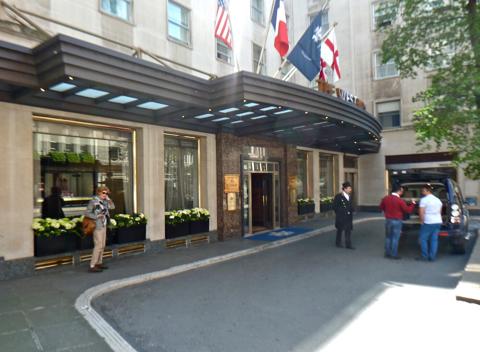
Quotation and dating note: the words attributed to Sir Hugh Forbes are as printed in the contemporaneous Sports Illustrated report of 2 July 1973, at https://vault.si.com/vault/1973/07/02/dark-fortnight-for-wimbledon. That report places the hearing "early last week" without giving a date, and a 2023 Tennis.com retrospective dates the judgment to 18 June 1973, which this memory follows. The board vote that came after it is pinned separately at the Westbury in Mayfair.
Coordinate: 51.513933, -0.113369, precision radius 150 metres. The pin is the building, not the courtroom, which no source consulted names. Two independent sources: the OpenStreetMap courthouse feature at 51.514219, -0.113217, and the Office for National Statistics centroid for postcode WC2A 2LL at 51.513647, -0.113521, retrieved through postcodes.io. They are 67 metres apart, and the published pin is their midpoint.
Cover: the Royal Courts of Justice seen from the Strand, 22 October 2016. Photograph by Robert Lamb for Geograph Britain and Ireland, CC BY-SA 2.0 via Wikimedia Commons.
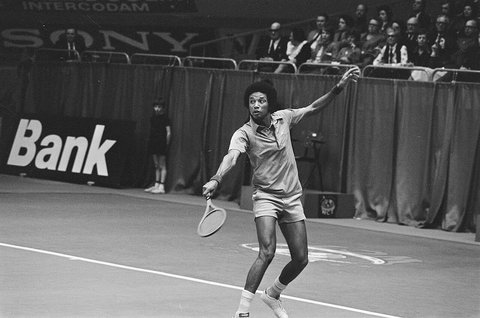
Second image: Nikola Pilić serving against Roche at Scheveningen, 5 July 1970, and not a photograph from 1973. Anefo / Nationaal Archief, CC0 via Wikimedia Commons. The archive caption describes the opponent as a Frenchman named Roche; the scoreboard visible behind him confirms the surname but not the nationality, and no French player of that name is recorded in the period. Read the nationality as an archive error.
































































 expand_more