
- Home
- Semiconductor History | The DRAM Wars | Boise, Tokyo, Hiroshima, Dresden, Hsinchu, Syracuse and San Francisco
- Semiconductor History | 3065 Bowers Avenue, October 1985 — The Company That Invented DRAM Walked Away From It
Semiconductor History | 3065 Bowers Avenue, October 1985 — The Company That Invented DRAM Walked Away From It
· 1985-10
Personal memoryBy kevin · · updated · Report an issue
Find memories left by people near you.
Distribute Bounty
This will distribute the bounty equally among all qualifying memories. This action cannot be undone.
Cancel Bounty
Are you sure you want to cancel this bounty? The remaining amount will be refunded to your account.
Success!
Operation completed successfully.
Error
Something went wrong.
Semiconductor History | 3065 Bowers Avenue, October 1985 — The Company That Invented DRAM Walked Away From It
kevin
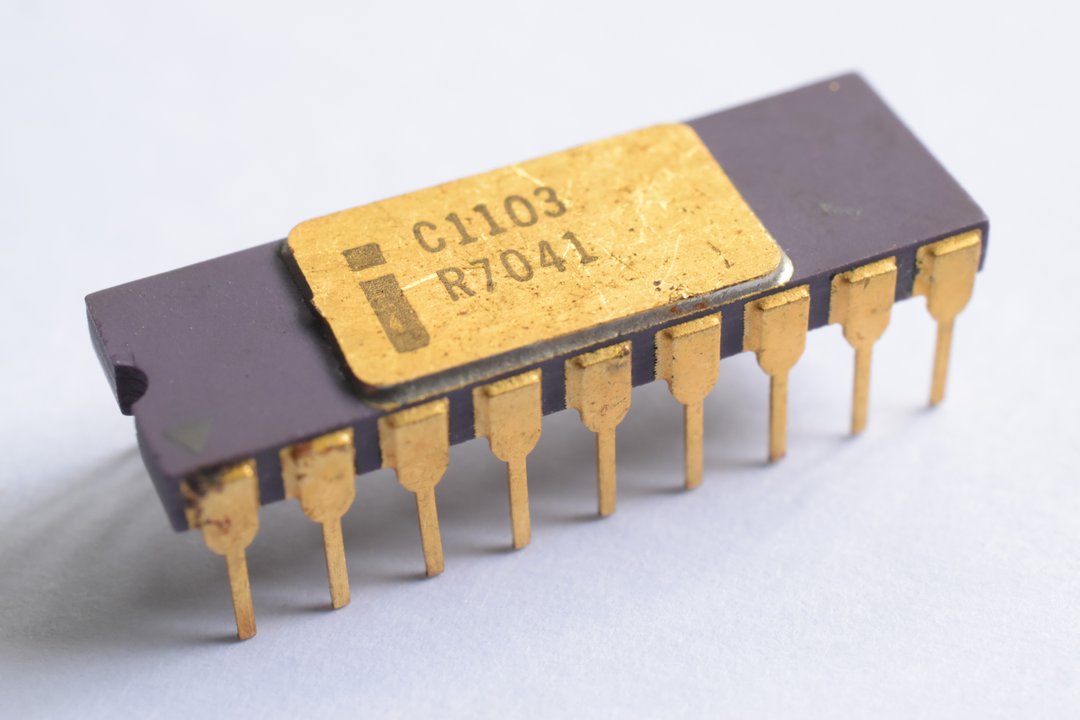
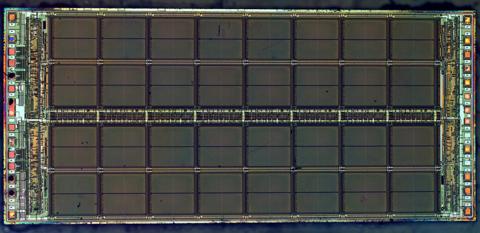
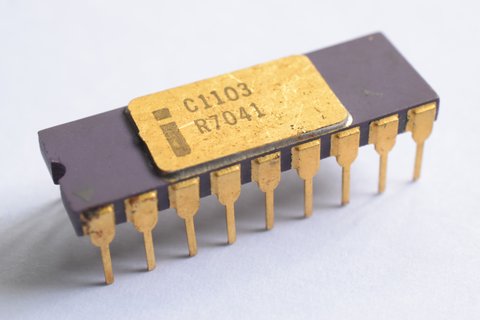
The chip in the photograph is an Intel C1103 with a 1970 date code. It holds 1,024 bits.
It was the first dynamic random access memory sold commercially in volume, it displaced magnetic core memory from computers, and by 1972 it was the best-selling semiconductor product in the world.
It is also the product Intel was built on. DRAM, and the memory business generally, carried the company from a two-man startup to the Fortune 500.
On 10 October 1985 Intel told its staff it was leaving that business.
The market had turned on them over the previous seven years. Japanese makers were shipping DRAM at prices Intel could not match, its own share of a market it had invented had collapsed, and the memory line was consuming about a third of research spending while returning a small fraction of revenue.
Gordon Moore and Andrew Grove worked through it by asking what a new management brought in from outside would do. The answer was obvious as soon as the question was put that way, and much harder for the people who had built the business.
Grove later described the decision as an emotional one, and also as the best business decision the company ever made.
A week later, on 17 October, Intel announced the 80386. It had cost around $100 million to develop, close to a tenth of the company's turnover when the project began, and by 1991 it accounted for roughly half of all Intel revenue.
That is the part usually told as a triumph. The other half is that thousands of Intel workers were laid off across the rest of the 1980s as the memory business wound down.
What the exit left behind is the shape of this whole collection. When the largest American semiconductor company walked away from DRAM, one Idaho company was left carrying the entire American position in memory, and it spent the next four decades fighting for it.
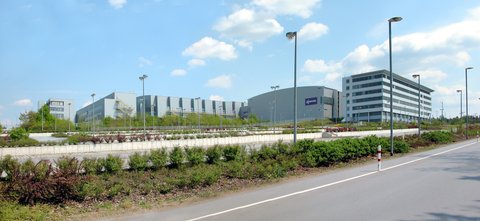
The address is where Intel's Santa Clara operations were then centred. The Mission College Boulevard headquarters most people picture did not exist yet; that site went through city rezoning in 1990 and the museum in the Robert Noyce Building opened in 1992.
Bowers Avenue is a working Intel campus with no public access, and the city has been reviewing redevelopment of the parcel since 2023.


Photo: Thomas Nguyen, CC BY-SA 4.0, via Wikimedia Commons
changes?
delete this memory?
We detected that you have a Blox in your crypto wallet! We will import the Blox into your account.
Click on done below to complete the import.
Welcome Back!
Sign in to preserve cherished moments
Don't have an account?
Welcome!!
Sign up and start preserving cherished moments
?
?
Choose your payment method
Buy with Metablox Credit
Do you want to mint Blox with Metablox Credit?
Which Crypto would you like to use?
Purchase Confirmed!
Your Blox is being minted on-chain and will appear in your profile shortly.
Log in or sign up to claim your Blox.
How many credits do you want to buy?
$100 USD = 1 Metablox Credit = 1 Blox.
Use Metablox Credit to mint any Blox you want on the map.
expand_more