NPB History | Yokohama Stadium — The First Night Game, Played in the Dark
volume_up
Listen
directions
Directions
Sunset in Yokohama on 17 August 1948 was at 7:29 in the evening. The league held the first pitch back until 8:08, on the reasoning that half-light would be harder on the players than proper darkness. That is how carefully Japanese professional baseball approached its first night game, and it still went wrong in ways nobody had thought of.
The ground was Yokohama Park's ballpark, requisitioned after the war by the occupation and renamed Lou Gehrig Stadium. The Americans had put lights in ahead of anyone else in Japan — but they were lights for servicemen playing recreational ball in their time off, and they were dim. The Giants played Chunichi in front of twenty thousand, with the promoter building temporary seating on the field itself for the crowd that would not fit.
Of everyone on the field, four men had played under lights before: the Giants' Shiraishi Toshio and Nakajima Haruyasu, and the umpires Nidegawa Nobuaki and Tsutsui Osamu, all from the Giants' 1936 tour of the United States. For everybody else it was the first time.
In the bottom of the first the Giants' Aota Noboru took a fastball from Chunichi's Hoshida Jirō in the face and left the game, apparently unable to pick the ball up. In the eighth, Kawakami Tetsuharu drove one to right; the runner Komatsubara Hiroki went for home and was called out; the ball had actually bounced once into the stands and come back out, and the umpires could not see well enough to rule. The game stopped for ten minutes. They settled on a ground-rule double and sent the runner back to third.
Chiba Shigeru, the Giants' leadoff man, remembered it plainly in old age: it was a night game, and it really was a night game, because you could not see the ball. He also remembered outfielders chasing a drive into the dark and finding three or four baseballs lying in the grass — the ones nobody had picked up after batting practice.
Only four night games were played in the whole single-league era. But twenty thousand people came, and that settled the commercial argument; after the leagues split in 1950 the ballparks started putting up lights one after another.
One correction worth making: the Japanese word *naitā* was not coined here. Chiba's own recollection notes it did not yet exist. It turns up in print about two years later.
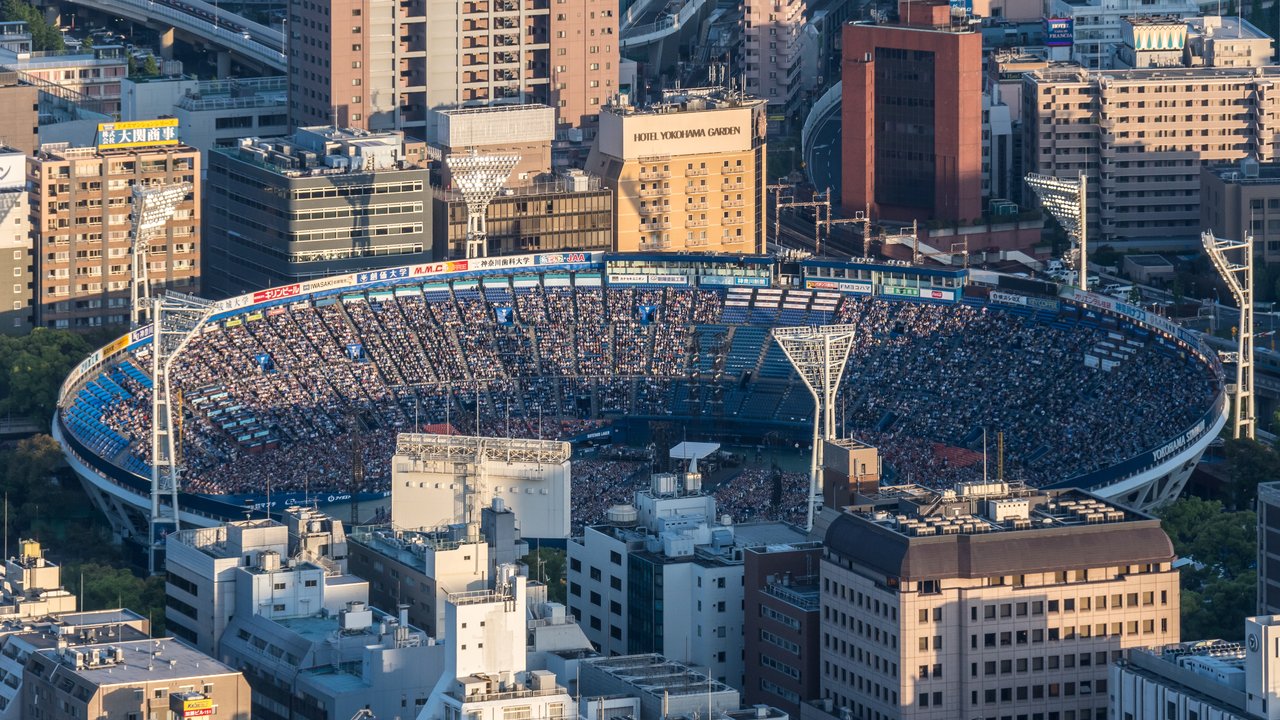
The ground itself is older than any of this. Laid out in 1876 as a park for foreign residents, its central lawn was a cricket pitch. On 23 May 1896 the First Higher School played the Yokohama Cricket Club here in what is counted as Japan's first international baseball match, which is why Yokohama calls itself the birthplace of Japanese baseball. The park was wrecked in the 1923 earthquake and rebuilt in 1929 as a proper ballpark, and in 1934 it hosted Ruth's touring Americans against Sawamura's all-Japan side. Returned to the city in 1952, renovated and renamed Yokohama Park Peace Stadium in 1955, it wore out; in 1972 a citizens' campaign gathered about 186,000 signatures for a replacement, and Yokohama Stadium opened on the same ground in 1978.
So the BayStars play on the spot where the lights first came on, and where the game was first played here at all.
Coordinates 35.443279, 139.640844 — Yokohama Stadium, in Yokohama Park; ±25 m, OSM map-verified, pending on-site check.
Cover: Yokohama Stadium, photographed 4 May 2017 by Chme82, CC BY-SA 4.0, via Wikimedia Commons. It shows the present ballpark on the site, not the 1948 one.























 expand_more