Tennis History | West Side Tennis Club, Forest Hills — the amateur who won the US Open forfeited $14,000 to the runner-up, September 1968
volume_up
Listen
directions
Directions
The United States ran two national championships in 1968 and the same man won both.
The US National Championships, the amateur-era event with a roll back to 1881, was held at the Longwood Cricket Club in Chestnut Hill, Massachusetts, roughly a month before the US Open. Arthur Ashe beat Bob Lutz in a five-set final. (https://www.tennis.com/news/articles/the-arthur-and-arthur-show-ashe-collins-and-the-1968-us-open) The event carried no prize money, would be discontinued after 1969, and is the last of the American amateur champions.
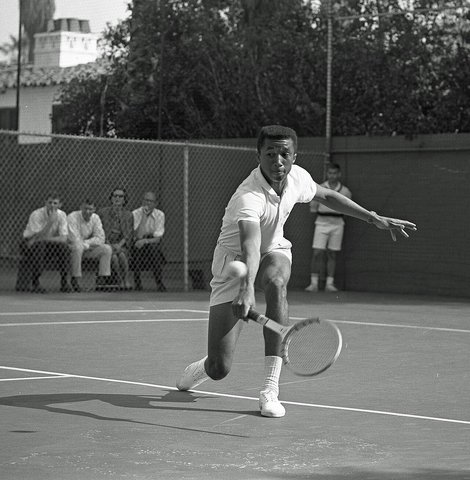
At the West Side Tennis Club in Forest Hills, from 29 August to 9 September, the same body — the USLTA — ran a second championship at the same rank, called the US Open, at which everyone in the professional troupes could enter and everyone in the field could be paid. Ashe played in that too. He beat Tom Okker of the Netherlands 14-12, 5-7, 6-3, 3-6, 6-3 in the final. Virginia Wade beat Billie Jean King 6-4, 6-2 in the women's. Both are recorded as the first US Open singles champions. (https://en.wikipedia.org/wiki/1968_US_Open_(tennis))
Ashe was twenty-five. He was a lieutenant in the US Army, on active duty at West Point sixty-five miles up the Hudson from Forest Hills, teaching computer programming to cadets and needing his superiors' permission to leave the base for each round. He had chosen to stay an amateur so he could continue to play Davis Cup for the United States; turning professional would have taken him off the team. Winning the first open US Championship on the roster of a national federation that had until that spring not permitted a professional to enter it meant, under the same federation's amateur rules, that he could not accept the prize money. The men's singles first prize was $14,000. Because Ashe won and was ineligible to be paid, the runner-up was paid: Okker, a Dutch player registered under a category that permitted prize money without the full professional status Ashe was avoiding, could take money that was owed to a champion he had not beaten. Sports Illustrated's later account gives Ashe's own take for the fortnight as sixteen days at $20 a day. (https://www.si.com/tennis/2018/09/12/arthur-ashe-1968-us-open-john-zimmerman-photos) The purse was $100,000. Wade won $6,000 for the women's title.
The Ashe cheque paid to Okker is the mechanism of the amateur rule made visible. Amateurism as a category had spent a century deciding which of two players got to be paid; on this particular Sunday it decided that the man who lost the final got paid because the man who won it was a serving US Army officer.
This is a separate event from the 1950 first-round match at the same club that put Althea Gibson on court there. The colour line at Forest Hills had been enforced by invitation and turned in 1950; the amateur line at Forest Hills was enforced by the same association's regulations and turned in 1968. The site holds both.
Coordinate: 40.71975, -73.84680, precision radius 250 m. This is the pin used for the 1950 Gibson memory at the same club, dual-sourced there against the US Census Bureau's TIGER geocoder for 1 Tennis Place (40.71990, -73.84669) and the GPS tag on that memory's cover image (40.71959, -73.84692); the two are about 40 m apart. The pin is the club grounds rather than a specific court. The stadium court on which the 1968 Ashe-Okker final was played is the 1923 horseshoe grandstand visible in this memory's cover image, at the north end of the site, and is inside this radius.
Cover image: "New York – Forest Hills – Tennis Courts", an aerial photograph of the West Side Tennis Club and its neighbourhood, National Archives and Records Administration item 68145479 (Records of the Bureau of Aeronautics), dated by the archive to a range of 1917 to 1964, public domain, via Wikimedia Commons. The photograph shows the horseshoe stadium at the top of the frame, the fan of grass courts spreading south-west from it towards the clubhouse, the Long Island Rail Road cutting across the bottom, and the tudor-brick blocks of Forest Hills Gardens covering the streets to the north. This is the layout the 1968 final was played on: grass, in the horseshoe visible at the top. The stadium was rebuilt on the same footprint after concerts of the seventies and is still there.




























 expand_more