NPB History | Kawasaki Stadium Site — 10.19, the Day the Clock Won
volume_up
Listen
directions
Directions
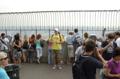
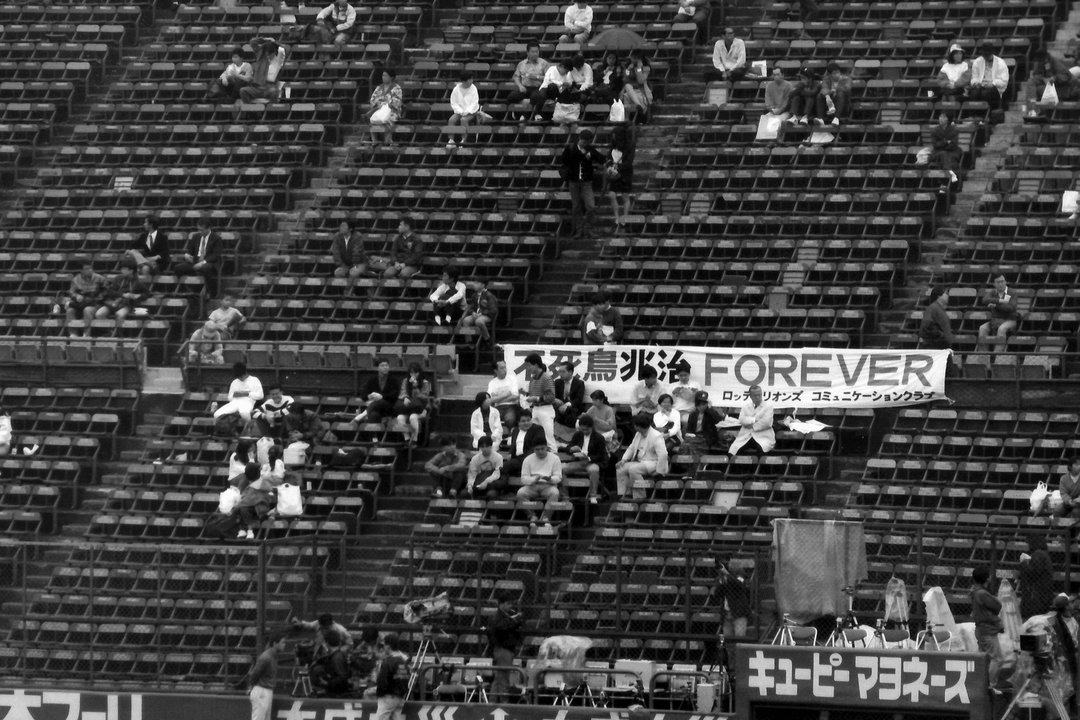
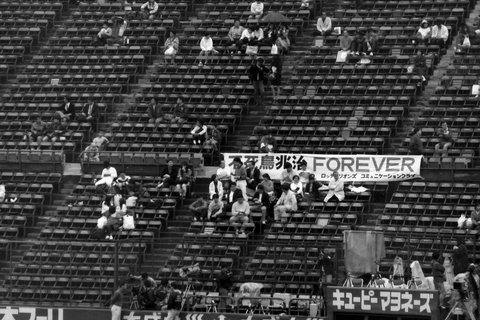
Kawasaki Stadium was the ballpark people made jokes about. Lotte's crowds were so thin that the empty seats became a national running gag, and a photograph taken here in October 1990 shows exactly that: a few dozen people scattered across a whole deck, a hand-painted banner slung over the rail reading Fushichō Chōji FOREVER for the pitcher Murata Chōji, and rows and rows of nothing.
On 19 October 1988 you could not get in.
The Pacific League season had been wrecked by rain. Three of four Lotte–Kintetsu games at Kawasaki were washed out at the end of September, and the fixtures were rebuilt so that the last of them fell here: one game on the 18th, a doubleheader on the 19th. It worked out that Kintetsu had to win both to take the pennant from Seibu. A draw would not do. Their manager, Ogi Akira, was in his first season, with a club that had finished last the year before.
Game one started at three in the afternoon. Ono Kazuyoshi, pitching on three days' rest, gave up a two-run home run to Aikō Takeshi in the first. Lotte, already certain of last place, were not playing out the string — their manager Aritō Michiyo had said his side had its own pride, and he started Ogawa Hiroshi, a ten-game winner. Down 1–3 in the eighth, Kintetsu tied it on a two-run double to left-centre by Murakami Takayuki. Under the rules of the day the first game of a doubleheader could not go to extra innings, so the ninth was all they had. Nashida Masataka, pinch-hitting, singled up the middle for the lead. Kintetsu won.
Game two began twenty-three minutes later and went to extra innings, and then the clock became the opponent. The rule was that no new inning could start after four hours. In the ninth Aritō argued a call for nine minutes. Those nine minutes were the game. Kintetsu got the tenth and nothing after it, and the second game finished a draw. The pennant stayed in Seibu's hands.
While all that was happening, the league it was happening in was coming apart. That same evening the news reached the press box that Hankyu had sold the Braves to Orient Lease, the company now called Orix — the Nankai Hawks had already been sold to Daiei the month before. Two of the six Pacific League clubs changed hands around the most famous game the league ever played. Sixteen years later Kintetsu itself would be merged out of existence by the company that bought Hankyu that night.
The ballpark had a long life aside from this. Professional clubs used it from 1952 to 1992, around 2,500 games; Oh Sadaharu's 700th home run and Harimoto Isao's 3,000th hit both happened here.
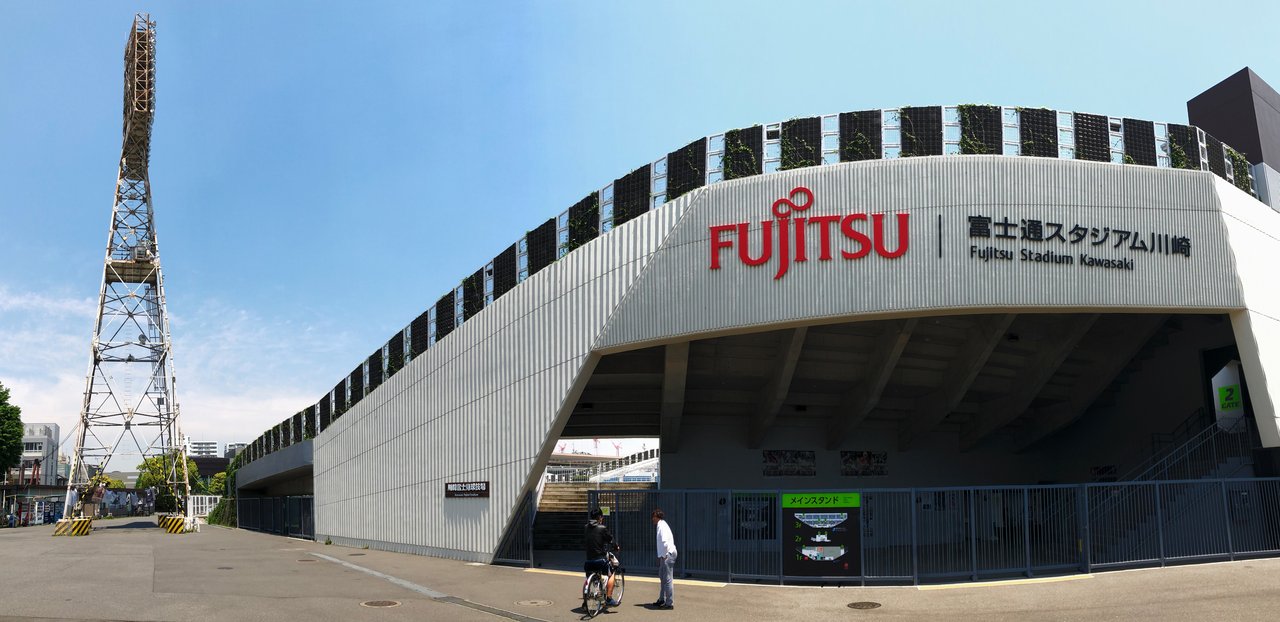
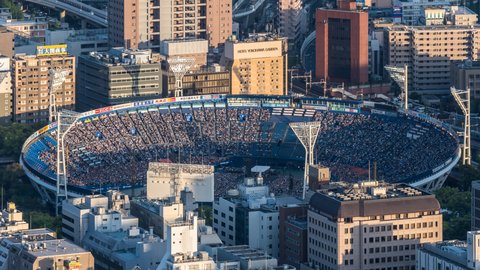
The site is now Fujitsu Stadium Kawasaki, a multi-purpose ground used mainly for American football, in Fujimi Park beside the Kawasaki velodrome. The operators have made a deliberate practice of keeping 10.19 alive, running commemorative talks and events, and fans turn up on 19 October every year without being asked to.
Go on the anniversary. It is one of the few vanished-ballpark pilgrimages in Japan that still has a congregation.
Coordinates 35.527092, 139.709656 — the Fujitsu Stadium Kawasaki playing field, on the ballpark footprint; ±60 m, OSM map-verified, pending on-site check.
Cover: the stands at Kawasaki Stadium on 13 October 1990, photographed by Hahifuheho, CC0. Second image: Fujitsu Stadium Kawasaki on the same ground, photographed 11 May 2019 by MIKI Yoshihito, CC BY 2.0. Both via Wikimedia Commons.

























 expand_more