Tennis History | Church Road, Wimbledon — the first open Championships paid the men two and two-thirds times the women, July 1968
volume_up
Listen
directions
Directions
The All England Club had voted with the LTA in December 1967 to abolish the amateur, and the international federation had been pushed into line at Place de la Concorde on 30 March 1968. What actually happened at Church Road when the Championships opened on 24 June 1968 was the first time a Wimbledon champion was paid, in front of the whole game. The rest of the tournament was a working demonstration of what the phrase "equal prize money" would come to mean if the four majors did not agree on it.
Rod Laver beat Tony Roche 6-3, 6-4, 6-2 in the men's final on Friday 5 July 1968 — the last Wimbledon men's singles final ever played on a Friday. Billie Jean King beat Judy Tegart 9-7, 7-5 in the women's the same weekend. (https://en.wikipedia.org/wiki/1968_Wimbledon_Championships)
The prize money the All England Club published for its first open tournament is the point. Laver was paid £2,000 for winning the men's singles; King was paid £750 for winning the women's. The men's doubles winners were paid £800 a pair; the women's doubles winners £500 a pair. The mixed doubles winners were paid £450 a pair. The total pool was £26,150.
A men's champion at the first open Wimbledon received about 2.67 times what a women's champion received. The winning men's doubles pair, at £800, was paid more than the women's singles champion. Nothing in the club's regulations said that a woman's contribution to the tournament was worth less than a man's; the ratios are what they are because the club chose them to be. The Championships would not equal the men's and women's singles prize money for the champions until 2007, and would not equal it across the draw until the same year. Thirty-nine tournaments passed between the first open Championships and equal prize money at the last of the four majors to reach it.
Laver's win was his first at Wimbledon as a professional. He had won it as an amateur in 1961 and 1962, then had been unable to enter for five years because he was being paid to play. The men's singles roll at Church Road runs 1962 R. Laver, then five years of no Laver, then 1968 R. Laver, and the gap is the record's exclusion of him. King had won it as an amateur in 1966 and 1967 and won it again in 1968, in the first year she could be paid for it. She was paid £750 for a repeat of what she had already done twice.
The mechanism used to fill the field was not a rule change alone. The professionals were touring in two organised troupes — the National Tennis League and World Championship Tennis — and both sent players to Wimbledon on the terms Wimbledon set. The championship the amateur roll had been so protective of was for the first time the tournament every good player wanted to enter and could.
Coordinate: 51.435344, -0.214852, precision radius 400 m. This is the same pin as the memory on the 1922 move of the ground to Church Road, dual-sourced there against the Wikidata entity for the All England Lawn Tennis and Croquet Club (Q815369) at 51.434494, -0.214447 and the Office for National Statistics postcode centroid for SW19 5AG via postcodes.io at 51.436193, -0.215256. The two lie 197 m apart across a site of roughly seventeen hectares. The pin is the site as a whole; Centre Court, where the Friday 5 July final was played, is inside this radius. The 1922 Centre Court was rebuilt in the 1930s, again after wartime bomb damage, and again with a roof in 2009, so almost nothing on court in 1968 remains on court now.
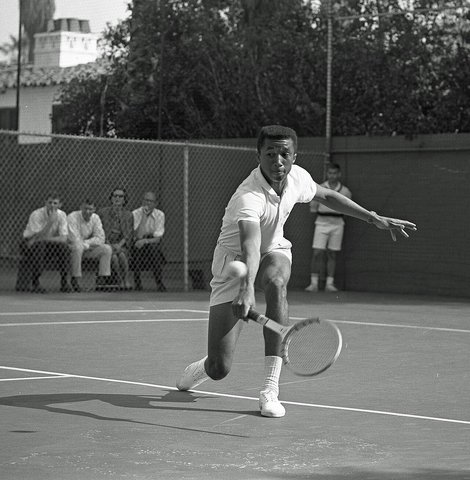
Cover image: Rod Laver in mid-swing on a clay court, Amsterdam, 22 May 1969, photographed by Joost Evers for Anefo, CC0 via the Nationaal Archief and Wikimedia Commons (Bestanddeelnr 922-4468). It is from the top-tennis tournament in Amsterdam in May 1969, not from Wimbledon 1968, but it is a contemporary press image of the man who won the first open Championships, playing a proper shot. He is dressed as he was in 1968 — white long-sleeved pullover, white shorts, a wooden racket — and the background of empty bleacher benches gives a fair picture of what most professional tennis outside a Grand Slam looked like at the end of the sixties. Laver was thirty at the time of the photograph and had just started what would be, later that year, his second career Grand Slam.














































 expand_more