Tennis History | Stade Roland-Garros, Paris — the first open major was held while the country was on strike, May 1968
volume_up
Listen
directions
Directions
The French Championships opened at Roland-Garros on 27 May 1968 and finished on 9 June. It was the first Grand Slam tournament in the Open era — the first at which a professional and an amateur could enter the same draw and be paid the same money if they got to the end of it. The tournament went ahead in a country largely shut down.
The French general strike had begun on 2 May and reached its peak in the third week, exactly when Roland-Garros was being played. Airports had closed; rubbish was piled in the streets; the telephones were unreliable. Nancy Richey, who won the women's singles, told the tournament's website years later that the American Federation Cup team had flown to Brussels and been driven into Paris by bus, and that she remembered the garbage and the telephones. (https://www.rolandgarros.com/en-us/article/richey-recalls-roland-garros-triumph-1968)
Ken Rosewall beat Rod Laver in the men's final 6-3, 6-1, 2-6, 6-2. It was the second time in five weeks the two had played each other for the trophy at the first open event of its kind: Rosewall had also beaten Laver in the final at Bournemouth on 28 April, in the British Hard Court Championships that had opened the Open era three weeks before Roland-Garros did. (https://en.wikipedia.org/wiki/1968_French_Open) Rosewall was thirty-three, had turned professional at the end of 1956 and had been unable to enter any of the four majors for the eleven seasons since. His comeback that spring is the argument for why the majors ought to have opened years before: the man barred from every major from 1957 through 1967 won the first two open tournaments of the new era at thirty-three.
Rosewall was paid 15,000 French francs, about $3,000 at the exchange rate of the day. Nancy Richey was owed roughly half that; she declined it, because taking it would have ended her amateur status and with it her place on the Federation Cup team. Being paid for winning had been legal for six months and the machinery for staying an amateur while doing it had not yet gone away. Her per diem from the USTA was $27, and she was not the only amateur in the field taking that kind of arrangement.
The Bournemouth-to-Paris sequence is the argument for how the Open era actually opened. The Lawn Tennis Association, a national body, ran a domestic championship at which everyone could play, and it happened first. The International Lawn Tennis Federation, meeting at Place de la Concorde on 30 March, then authorised twelve tournaments at which the same rule would apply. Roland-Garros was the first of the four majors on that list to come round in the calendar, and so became the first open major almost by accident of scheduling. Wimbledon opened three weeks after Roland-Garros finished; Forest Hills three months after that.
Coordinate: 48.846576, 2.248896, precision radius 350 m. This is the same pin as the memory on the 1928 building of the stadium (Stade Roland-Garros, Porte d'Auteuil), verified there against two independent sources — Wikidata Q22690 for the stadium at 48.846282, 2.249374, and the French national mapping agency's Géoplateforme geocoder returning 48.847432, 2.250901 for 2 Avenue Gordon Bennett, the ground's street address. They lie about 170 m apart across a complex of roughly 13.5 hectares. The pin is the site as a whole; the specific court on which the 1968 final was played would today be Court Philippe-Chatrier, and its position within the site is inside this radius.
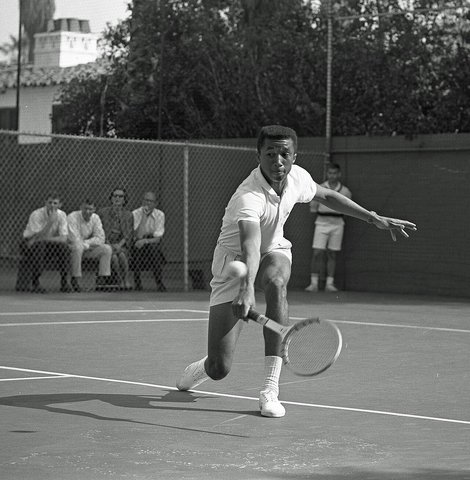
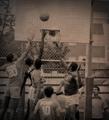
Cover image: Ken Rosewall in action against Tom Okker on clay, Scheveningen, 5 July 1970, Anefo press photograph, CC0 via the Nationaal Archief and Wikimedia Commons (Bestanddeelnr 923-6454). The photograph is from two years after the 1968 Roland-Garros final, at a Dutch tournament, not the French one. It shows Rosewall stretching low for a forehand volley on a clay court with a chain-link fence behind him and a Dunlop hoarding beyond that. Rosewall was thirty-five here and dressed as he was in 1968 — long-sleeved cricket-style pullover, white shorts, canvas shoes. The frame is the closest contemporaneous image of Rosewall on clay that is properly licensed.
Second image: Court Philippe-Chatrier photographed from the upper stand, 1 June 2007, by Ji-Elle, released to the public domain via Wikimedia Commons. It shows the modern rebuilt centre court during a match, packed to capacity, and is included only to place the reader inside the ground; almost nothing in the 2007 frame dates from 1968.






































 expand_more