


Dynastic History | The Bayon, Angkor Thom — Fourteen Metres Under the Central Shrine
· 1933-8
Personal memoryBy kevin · · Report an issue







































Find memories left by people near you.
Distribute Bounty
This will distribute the bounty equally among all qualifying memories. This action cannot be undone.
Cancel Bounty
Are you sure you want to cancel this bounty? The remaining amount will be refunded to your account.
Success!
Operation completed successfully.
Error
Something went wrong.
Dynastic History | The Bayon, Angkor Thom — Fourteen Metres Under the Central Shrine
kevin
Georges Trouvé had been conservator of Angkor for a matter of months when, on 16 August 1933, he began sinking a shaft through the pavement of the Bayon's central shrine. The pit went down roughly fourteen metres, to the water table. From the following day fragments came up, most of them within the first five metres: a Buddha seated in meditation under the spread hood of the serpent Mucalinda, cut in white sandstone, about 3.6 m tall and 4.7 m with its octagonal pedestal.
By October the pieces had been fitted back together in a courtyard below. On 17 May 1935 the image was installed and reconsecrated at Prasat Prampil Lavaeng, a Buddhist terrace on the road east of the temple, where it stands and takes offerings now.
The familiar explanation is that the statue was dragged out of the sanctuary and broken up during a Hindu reaction under Jayavarman VIII in the thirteenth century. Martin Polkinghorne, Christophe Pottier and Christian Fischer set that account against the physical evidence in the Journal Asiatique in 2013 and argued the image was still being venerated in the fifteenth century, which leaves both the date of the breakage and the hand behind it unsettled.
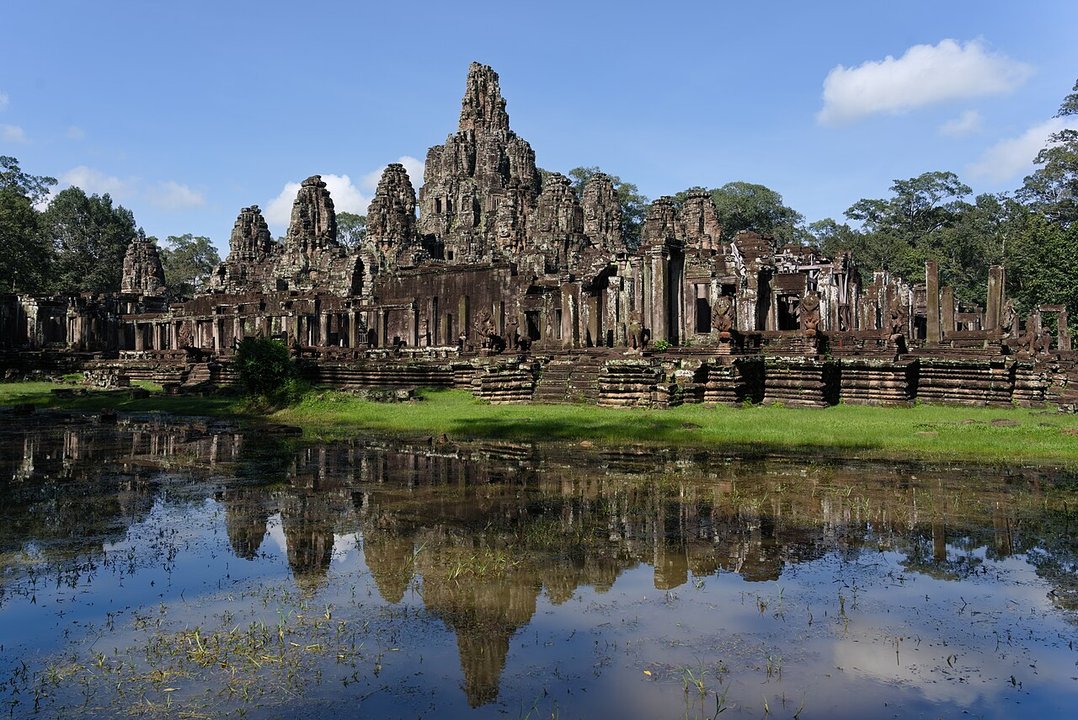
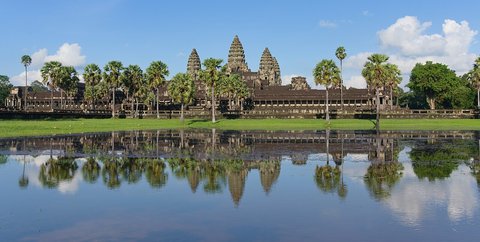
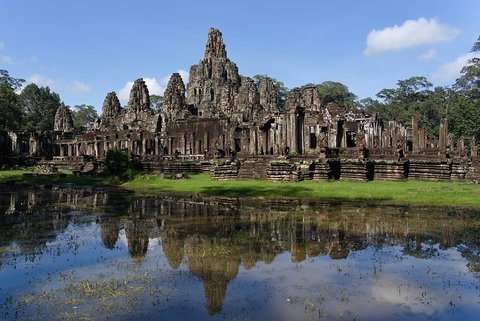
The Bayon was the state temple of Jayavarman VII, built at the centre of Angkor Thom late in the twelfth century or early in the thirteenth. Its outer gallery reliefs are the reason to walk the perimeter first: markets, cooking fires, a cockfight, boats, marching columns — the people who fed and carried the capital, in a building that otherwise records only the king who commissioned it. The temple sits inside the ticketed park administered by APSARA.
📸 Cover: the Bayon from the east, Satdeep Gill, CC BY-SA 4.0 via Wikimedia Commons
changes?
delete this memory?
We detected that you have a Blox in your crypto wallet! We will import the Blox into your account.
Click on done below to complete the import.
Welcome Back!
Sign in to preserve cherished moments
Don't have an account?
Welcome!!
Sign up and start preserving cherished moments
?
?
Choose your payment method
Buy with Metablox Credit
Do you want to mint Blox with Metablox Credit?
Which Crypto would you like to use?
Purchase Confirmed!
Your Blox is being minted on-chain and will appear in your profile shortly.
Log in or sign up to claim your Blox.
How many credits do you want to buy?
$100 USD = 1 Metablox Credit = 1 Blox.
Use Metablox Credit to mint any Blox you want on the map.
 expand_more