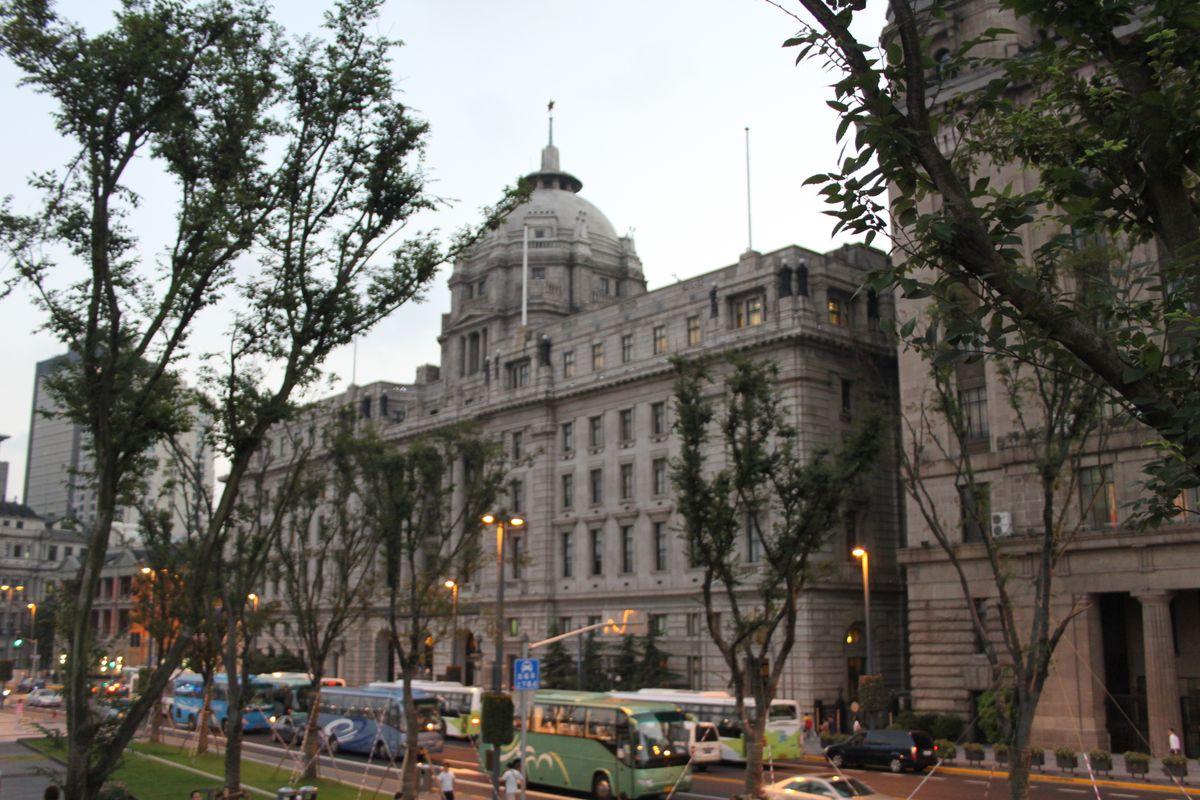
Finance History | HSBC Building, 12 The Bund, Shanghai, 1923 — A Branch Office the Size of a Government
volume_up
Listen
directions
Directions
The Hongkong and Shanghai Banking Corporation began in a hotel. Its Shanghai branch opened on 4 March 1865 on the ground floor of the Central Hotel, at the corner of the Bund and Nanjing Road.
By 1874 it had outgrown that and bought the Foreign Club, a three-storey building at number 12 on the Bund, just south of the Customs House, for 60,000 taels of silver. It acquired numbers 10 and 11 in 1912.
Then it built something out of proportion to a branch office.
Construction ran from 5 May 1921 to 23 June 1923, to a design by Palmer and Turner, the British firm responsible for roughly half the Bund. The result covers about 23,415 square metres and was described at the time as the largest bank building in the Far East.
Inside the entrance is an octagonal hall with a ceiling more than twenty metres up, carrying eight mosaic panels assembled from hundreds of thousands of tiles a few centimetres across, and twenty-eight Italian marble columns thirteen metres tall, four of them cut from single blocks.
The reason a branch needed this is the point of the entry.
Shanghai's foreign banks were not operating inside somebody else's financial system. Under the treaty port arrangements they largely were the financial system for foreign trade: issuing notes that circulated, holding the deposits of the Chinese customs revenue, financing the tea and silk and opium trades, and doing it on a strip of riverfront governed under extraterritoriality rather than Chinese law.
A row of monumental bank headquarters facing the water is what that arrangement looks like when it is built in stone. The Bund is an argument about jurisdiction as much as a skyline.
The building outlasted the arrangement. HSBC occupied it from 1923 until 1955, after which it became the seat of the Shanghai municipal government, and it now houses the Shanghai Pudong Development Bank.
Two claims to be careful with, because both circulate widely. This was not the tallest bank in the world; the superlatives attached to it concern floor area, and the comparison usually made is with the Bank of Scotland's building in Edinburgh. And HSBC did not stay until the 1990s, which some guides state; it left in 1955.
Read this alongside the Seoul entry in this collection. Both are buildings put up by an outside power to run somebody else's money, and both are now occupied by the domestic institutions that replaced them.
Cover photo: Gary Todd, CC0, via Wikimedia Commons.
Coordinates 31.238005, 121.485757, resolved by Nominatim for 前汇丰银行大楼 at 12 the Bund and matching a cluster of Commons geotags within about 20 m.





 expand_more