Finance History | Rue Quincampoix, Paris, 22 March 1720 — The Only Share Market Whose Address the State Chose
volume_up
Listen
directions
Directions
On 22 March 1720 the French government closed this street to trading, which makes Paris the one great share market of the era whose address was chosen by the state.
Dealing had filled the rue Quincampoix since 1719, in the open air, around the premises where John Law's business was done.
The company went through names. It was the Compagnie d'Occident from August 1717, then the Compagnie des Indes after a royal edict of 21 May 1719, and everyone called it the Mississippi Company regardless.
Its shares stood at roughly 500 livres in early 1719 and reached about 10,000 livres by January 1720, though the figures quoted for the peak vary by source.
The engine underneath was a loop rather than a story about Louisiana.
Investors bought shares with notes from the Banque Royale, and the bank issued more notes, which funded more share purchases. In February 1720 Law's company absorbed the bank outright, so a single institution was now printing the money used to buy the shares it issued.
Inflation in France ran at about 23 per cent in the month of January 1720 alone.
The closure came out of violence rather than economics. A share dealer was murdered in a tavern on this street, and the nobleman responsible was arrested, tried and executed.
Jean Buvat, keeping his chronicle of the Regency at the time, sets the sequence down in order: the killing of a dealer, the arrest, the trial, the sentence, and then assemblies in the rue Quincampoix forbidden.
The market was moved rather than abolished. It went first to the place Vendôme, then to the garden of the Hôtel de Soissons, and in October 1720 to the rear garden of the Hôtel de Nevers.
Set that against the other two cities and the difference is the whole point. Amsterdam's traders took a bridge and a chapel because those were already there, and London's took a coffee house because the Royal Exchange threw them out.
In both, the venue was chosen by the people using it and the authorities arrived afterwards. In Paris the authorities chose, and the exchange that eventually became the Paris Bourse descends from a market that was told where to stand.
One caution for anyone reading further. The best-known details of this street, the hunchback who rented out his back as a writing desk and the cobbler who grew rich hiring out chairs, come from Charles Mackay in 1841 and cannot be traced to a contemporary record.
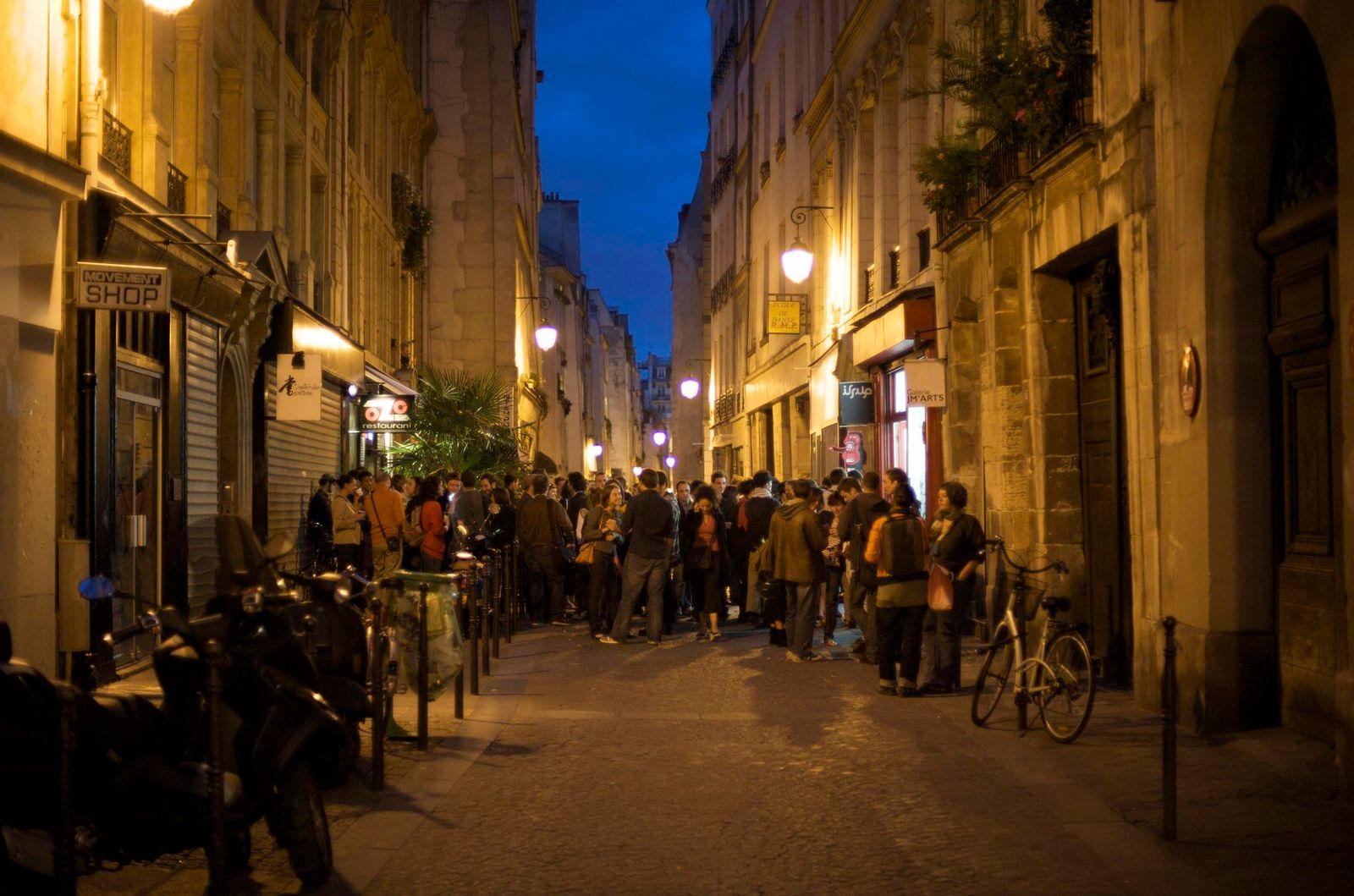
The rue Quincampoix is still narrow and still fills up at night, as the photograph shows, though the crowd now is drinking rather than dealing.
Photo: THOR, CC BY 2.0, via Wikimedia Commons — the street on an evening in 2008.







 expand_more