Finance History | Change Alley, London, 1720 — The Bubble Is Remembered, the Price List Was the Invention
volume_up
Listen
directions
Directions
This passage is remembered for a crash, but the thing it actually contributed to finance was a printed list of prices.
Change Alley, called Exchange Alley in the seventeenth century, runs between Cornhill and Lombard Street, directly opposite the Royal Exchange.
Traders were here because the Royal Exchange would not have them. Stock jobbers were pushed out for their manners and set up instead in the alley's coffee houses, chiefly Jonathan's and Garraway's.
That is the same pattern as Amsterdam, where the share trade was worked in a chapel and on a bridge rather than in any building meant for it.
In 1698 a broker named John Castaing began issuing a regular list of stock, commodity and currency prices from Jonathan's, under the title The Course of the Exchange.
A buyer could now find out what things had traded at without knowing anyone. That is price discovery made public, and it is a better claim to being the beginning of the London market than any of what followed.
What followed, in 1720, was the South Sea Company.
Its stock stood at about £128 in January of that year, passed £1,000 by August, and was back to roughly £150 by December, all figures in pounds of 1720.
Two things in the popular account need correcting.
The Bubble Act is usually described as the response to the crash. It was passed in June 1720, during the mania and months before the September collapse, and the South Sea Company supported it because it suppressed the rival subscription ventures competing for the same money.
Regulation aimed at competitors rather than at speculation.
The Isaac Newton story is shakier still. Andrew Odlyzko's study for the Royal Society found that the familiar tale rests on very few pieces of hard evidence, several of them consistently misquoted, and that the line about calculating the heavens but not the madness of people has no contemporary source.
Odlyzko's own archival work does support the losses, since Newton moved heavily into the stock close to its peak. John Maynard Keynes had argued the opposite, that Newton came through the year ahead.
The alley kept working after the bubble and burned in the Cornhill fire of 1748.
In 1773 the brokers finally left, taking a building in Sweeting's Alley that they called New Jonathan's, and that institution became the London Stock Exchange.
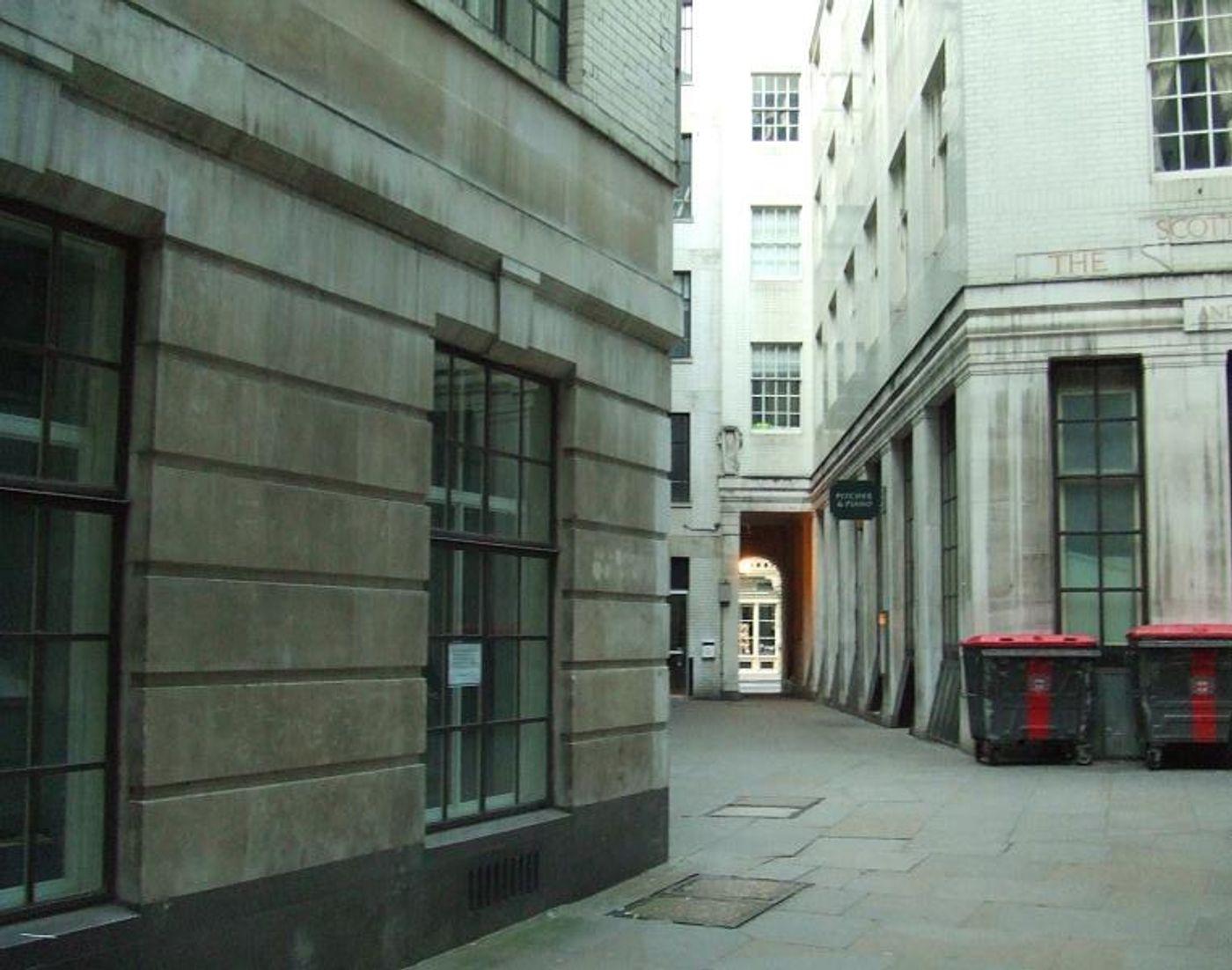
Change Alley today is a narrow cut-through hemmed in by office blocks, easy to walk past. A plaque marks where Jonathan's stood, and the exchange that grew out of it now sits at Paternoster Square, a mile west.
Photo: Matt Brown, CC BY 2.0, via Wikimedia Commons — looking east along the alley.














 expand_more