Finance History | Amsterdam Town Hall, 1609 — The Wisselbank Turned Coins into Ledger Money
volume_up
Listen
directions
Directions
In 1609, Amsterdam established the Wisselbank in the old town hall on Dam Square to make settlement more reliable in a city crowded with coins of different origins and uncertain metallic value.
Merchants brought specie to the bank, where accepted coins could be assessed and credited to an account in standardized bank money.
Payments between account holders could then be made by book transfer, allowing value to move across a ledger without repeatedly carrying, weighing, and testing bags of coin.
This separation between the circulating coins people handled and the accounting unit used for large payments reduced the disruption caused by clipping, wear, debasement, and fluctuating exchange rates among coins.
Amsterdam required important bills of exchange to be settled through the bank, which helped draw merchants into a common payment network.
The mechanism worked because each transfer produced matching entries on the bank’s books, creating a final local payment that did not depend on a chain of privately issued promises.
Municipal oversight added credibility, although the Wisselbank’s history also showed that public sponsorship could not eliminate governance risk or prevent later departures from strict reserve practice.
For much of the seventeenth century, its bank money became a trusted settlement medium for Amsterdam’s international merchants and supported a broader market in bills, commodities, shipping, and securities.
The bank was not a modern retail bank and did not initially exist to offer ordinary households savings accounts or consumer loans.
Its purpose was narrower and infrastructural: to provide merchants with stable accounting and dependable transfer at the center of a complex trading economy.
The wealth settled through these ledgers included proceeds from the Dutch Republic’s global commerce, including colonial enterprises and systems of exploitation, so technical payment efficiency cannot be separated from the uses to which the commercial network was put.
The old town hall burned in 1652, and the present Royal Palace occupies its successor site, while the Wisselbank continued elsewhere in the civic complex before finally closing in 1820.
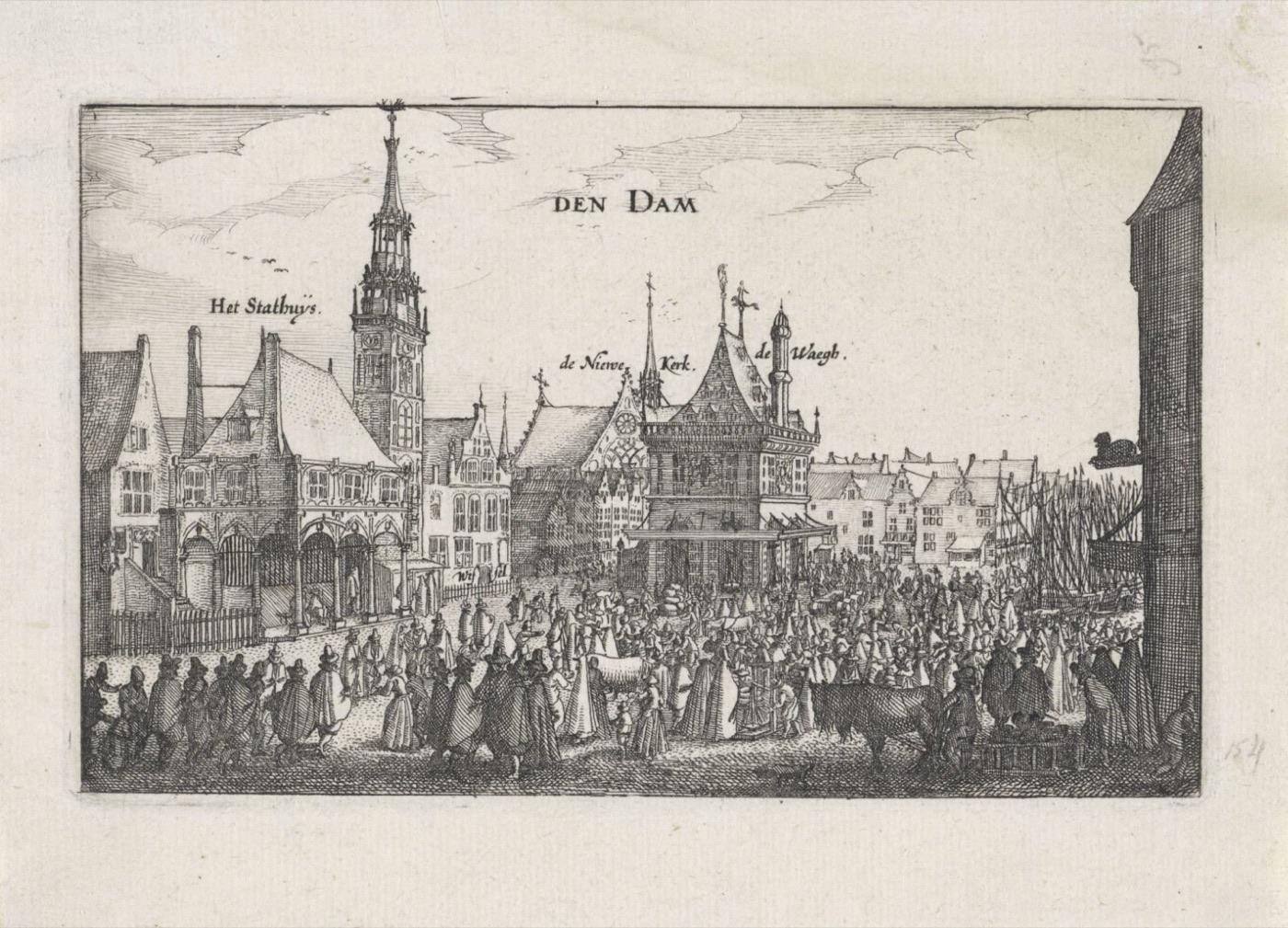
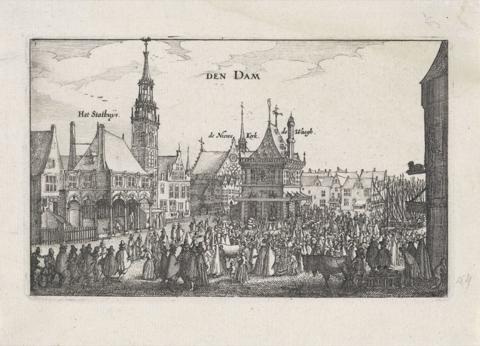
The pin marks the vanished institutional site, and the period image identifies the old town hall and Wisselbank on Dam Square alongside the New Church and Weigh House.
Image: Claes Jansz. Visscher II/Rijksmuseum, CC0, via Wikimedia Commons.





_thumbnail.jpg)







 expand_more