


Dynastic History|Shrine of Sheikh Safi al-Din, Ardabil — The Lodge That Edited Its Own Descent
· 1358
Personal memoryBy kevin · · Report an issue







_at_World_Economic_Forum_Davos_2023.png)



















































Find memories left by people near you.
Distribute Bounty
This will distribute the bounty equally among all qualifying memories. This action cannot be undone.
Cancel Bounty
Are you sure you want to cancel this bounty? The remaining amount will be refunded to your account.
Success!
Operation completed successfully.
Error
Something went wrong.
Dynastic History|Shrine of Sheikh Safi al-Din, Ardabil — The Lodge That Edited Its Own Descent
kevin
The Safavids began as a Sufi order, not a royal house. Safi al-Din Ardabili (1252–1334) led a khānegāh, a Sufi lodge, in this town on the northwestern edge of the Iranian plateau, and around 759/1358 one of his followers, Ibn Bazzaz, finished the Safwat al-Safa: more than eight hundred folios of the sheikh's sayings and miracles, compiled while the order's authority was still spiritual rather than territorial.
The text did not stay as written. A manuscript copied in 914/1508, during the reign of Ismail I, already carried ideologically motivated changes, and Shah Tahmasp later commissioned a further revision. The alterations did two things: they obscured the family's Kurdish origins, and they supplied descent from the Shi'ite Imams, a genealogy a shah ruling in the name of Twelver Shi'ism required and the fourteenth-century original had not provided. Z. V. Togan and Ahmad Kasravi traced the interpolations through the surviving manuscripts in work published between the 1920s and 1957. The dynasty's claim to sayyid status is read now as a claim with a compositional date attached, not as a lineage.
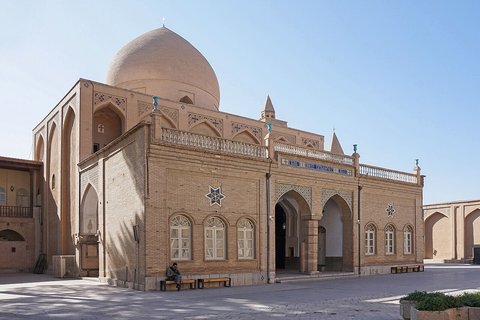
The lodge was built up into a dynastic monument accordingly. The oldest fabric is fourteenth-century — the Haramkhana of 1324 and Safi al-Din's tomb tower of 1345 — and the ensemble around it, with its mosque, library, school, hospital, kitchens, cistern and mausolea, was elaborated between the early sixteenth century and the late eighteenth. Ismail I, who died in 1524, was buried here in a tomb chamber raised by his widow Tajlu Khanum between 1524 and 1529, beside the sheikh whose genealogy his chancery had improved.
UNESCO listed the ensemble in 2010. It remains a working shrine under Iran's cultural heritage authority, and still receives pilgrims.
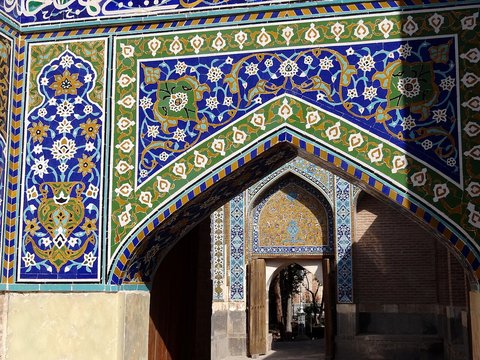
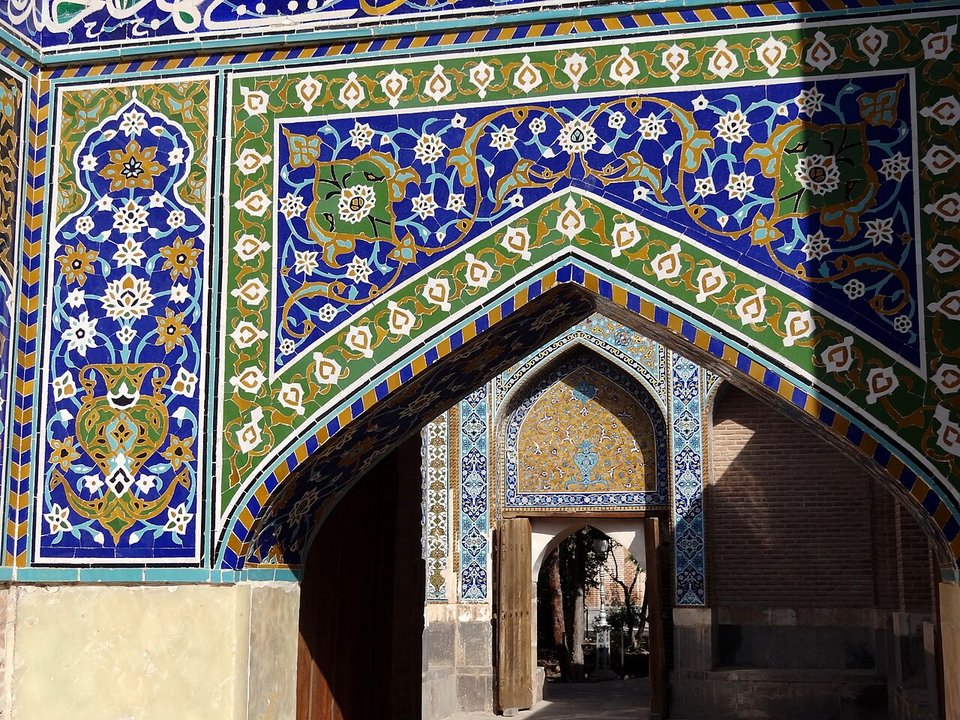
📸 Cover: the tiled entrance gateway of the Sheikh Safi mausoleum, Adam Jones, CC BY-SA 2.0 via Wikimedia Commons. A detail of the complex, not a general view.

_at_World_Economic_Forum_Davos_2023_thumbnail.png)

changes?
delete this memory?
We detected that you have a Blox in your crypto wallet! We will import the Blox into your account.
Click on done below to complete the import.
Welcome Back!
Sign in to preserve cherished moments
Don't have an account?
Welcome!!
Sign up and start preserving cherished moments
?
?


Choose your payment method
Buy with Metablox Credit
Do you want to mint Blox with Metablox Credit?
Which Crypto would you like to use?
Purchase Confirmed!
Your Blox is being minted on-chain and will appear in your profile shortly.
Log in or sign up to claim your Blox.
How many credits do you want to buy?
$100 USD = 1 Metablox Credit = 1 Blox.
Use Metablox Credit to mint any Blox you want on the map.
 expand_more