


Dynastic History|Mahanavami Platform, Hampi — The Court's Stand, and the Six Months After
· 1565
Personal memoryBy kevin · · Report an issue




























































Find memories left by people near you.
Distribute Bounty
This will distribute the bounty equally among all qualifying memories. This action cannot be undone.
Cancel Bounty
Are you sure you want to cancel this bounty? The remaining amount will be refunded to your account.
Success!
Operation completed successfully.
Error
Something went wrong.
Dynastic History|Mahanavami Platform, Hampi — The Court's Stand, and the Six Months After
kevin
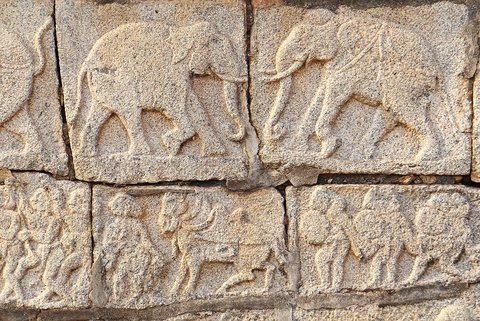
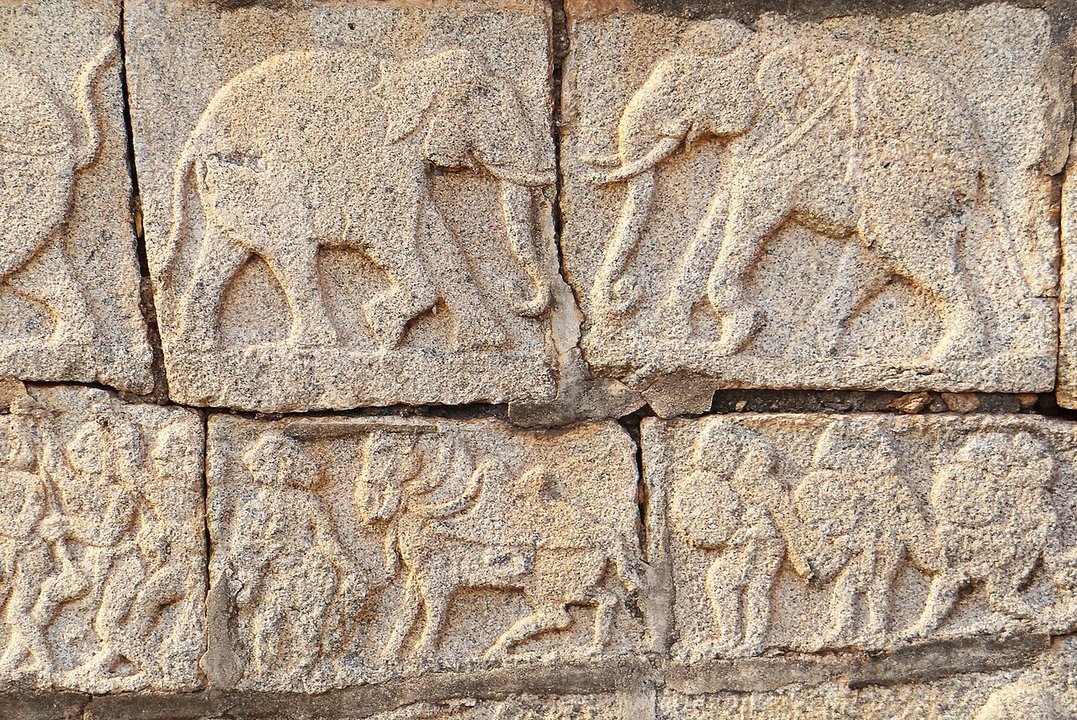
The largest thing in the royal enclosure at Vijayanagara is not a building but a platform: a stepped granite mass in the walled precinct at the south of the site, its base cut in courses of relief — elephants walking in line, horses with their handlers, soldiers, attendants, dancers. It takes its name from Mahanavami, the autumn festival at which the court put itself on display, reviewed its forces and received what the provinces owed. Whatever stood on top was of timber and is gone; the granite is the whole of it now.
The processions carved here are the court's own picture of itself, and also a record of who was required to walk in them. The same parade runs in bands round the outer wall of the royal chapel a few hundred metres north: marching elephants, then horses with horsemen, then soldiers, then dancers and musicians. The site history by John Fritz and George Michell reads that wall as the Mahanavami and spring festivals, and notes that it matches the descriptions in memoirs left by visitors to the city. One of those visitors, the Portuguese trader Domingo Paes, arrived with a contingent from Goa in 1520.
In 1565 a confederacy of the Deccan sultanates defeated the empire's army and took the capital. UNESCO's listing records that the city was then pillaged over six months and abandoned. How much of the ruin now visible belongs to those months is not settled: Mark Lycett and Kathleen Morrison argued in 2013 that the fall of Vijayanagara has been constructed by later historical writing as much as by the sack, and that the archaeological record is more awkward than the story. Both readings are in print and neither is closed.
The platform is signposted and open to walk around, inside a precinct the Archaeological Survey of India has been excavating since 1976.
📸 Cover: carved courses of the platform base, elephants above and horses and attendants below (not a general view), Jean-Pierre Dalbéra, CC BY 2.0 via Wikimedia Commons
changes?
delete this memory?
We detected that you have a Blox in your crypto wallet! We will import the Blox into your account.
Click on done below to complete the import.
Welcome Back!
Sign in to preserve cherished moments
Don't have an account?
Welcome!!
Sign up and start preserving cherished moments
?
?





Choose your payment method
Buy with Metablox Credit
Do you want to mint Blox with Metablox Credit?
Which Crypto would you like to use?
Purchase Confirmed!
Your Blox is being minted on-chain and will appear in your profile shortly.
Log in or sign up to claim your Blox.
How many credits do you want to buy?
$100 USD = 1 Metablox Credit = 1 Blox.
Use Metablox Credit to mint any Blox you want on the map.
 expand_more