


Concert History | Rice Stadium — A Three-Day Stage Build Displaced a School Competition
· 1994-10
Personal memoryBy kevin · · Report an issue















Find memories left by people near you.
Distribute Bounty
This will distribute the bounty equally among all qualifying memories. This action cannot be undone.
Cancel Bounty
Are you sure you want to cancel this bounty? The remaining amount will be refunded to your account.
Success!
Operation completed successfully.
Error
Something went wrong.
Concert History | Rice Stadium — A Three-Day Stage Build Displaced a School Competition
kevin
<!-- concert-queue-id: 1170; dedup-key: the rolling stones|1994-10-23|rice stadium|salt lake city -->
On Sunday, October 23, 1994, the Rolling Stones brought the Voodoo Lounge Tour to the University of Utah’s Rice Stadium in Salt Lake City, with Seal opening. The operating fact began two days before the performance: promoter Jim McNeil said more than 250 workers would take October 21–23 to erect the touring stage. A contemporary announcement put that structure at more than 220 feet long, 90 feet wide, 85 feet deep and 100 feet high. [Deseret News, September 14, 1994](https://www.deseret.com/1994/9/14/19130685/utah-fans-of-stones-can-get-satisfaction/)
Those setup days already belonged to someone else. The university-sponsored Western States Marching Band Competition had been booked at Rice Stadium for October 21–22, involving about 3,000 students from 25 bands. University vice president Ted Capener said the concert had first been proposed for October 26, but a second Oakland show forced Salt Lake City to accept October 23 or lose the booking. The contract anticipated moving the band contest to Franklin Quest Field; administrators later concluded that a baseball park could not accommodate drills designed for a football field. The competition was first reported canceled, then ultimately moved forward to October 17 at Rice Stadium. [Deseret News, September 24, 1994](https://www.deseret.com/1994/9/24/19132538/bands-are-crushed-that-stones-stole-their-show/) [Deseret News editor’s note, October 22, 1994](https://www.deseret.com/1994/10/22/19137756/why-did-stones-get-top-priority/)
This was a venue-conversion conflict, not simply a crowded calendar. The Los Angeles Times independently described the tour’s stadium set as nine stories high, 100 feet deep and as much as 300 feet wide. In Salt Lake City, three construction days for that fixed touring system displaced an educational event from its original weekend. The university’s pre-concert accounting projected $106,000 from its contract share, special-seat sales, parking and concessions; that figure was a forecast, not a reported final receipt. [Los Angeles Times, July 31, 1994](https://www.latimes.com/archives/la-xpm-1994-07-31-ca-21842-story.html) [Deseret News, September 24, 1994](https://www.deseret.com/1994/9/24/19132538/bands-are-crushed-that-stones-stole-their-show/)
A next-day report confirms that the concert occurred on October 23: gates opened at 5:30 p.m., city and university police managed traffic and parking, and the show ended with fireworks at 10:47 p.m. [Deseret News, October 24, 1994](https://www.deseret.com/1994/10/24/19138291/lots-of-anticipation-parking-eating/)
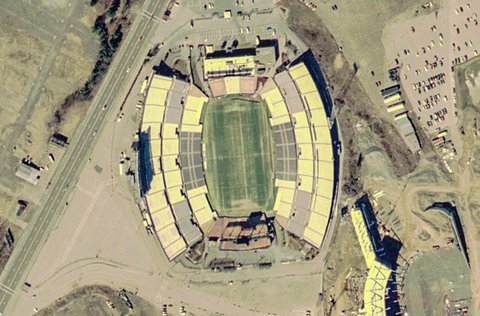
**Coordinate method and precision.** The pin, 40.760000, -111.848889, marks the center of the stadium footprint. Wikidata places today’s Rice–Eccles Stadium there. The U.S. Census Geocoder places its official 451 South 1400 East address at 40.759625, -111.850160, about 115 metres away. University of Utah records state that Rice–Eccles was built on the same ground as Rice Stadium; the 1998 rebuild retained only the south end zone and field surface. A 220-metre radius therefore covers the historical bowl footprint, the successor stadium and the address-point difference. [Wikidata](https://www.wikidata.org/wiki/Q922761) [U.S. Census Geocoder](https://geocoding.geo.census.gov/geocoder/locations/onelineaddress?address=451%20South%201400%20East%2C%20Salt%20Lake%20City%2C%20UT%2084112&benchmark=Public_AR_Current&format=json) [University of Utah Athletics](https://utahutes.com/news/1999/6/21/Football_Hosts_Hawai_i)
**Venue status, checked September 9, 2026.** Rice Stadium stood from 1927 through 1997 and had carried Robert Rice’s name since 1972. Its successor, Rice–Eccles Stadium, operates at the same site. [University of Utah Athletics](https://utahutes.com/news/2022/11/3/football-photo-essay-25-seasons-of-rice-eccles)
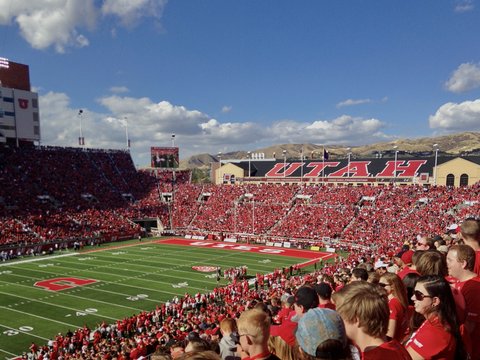
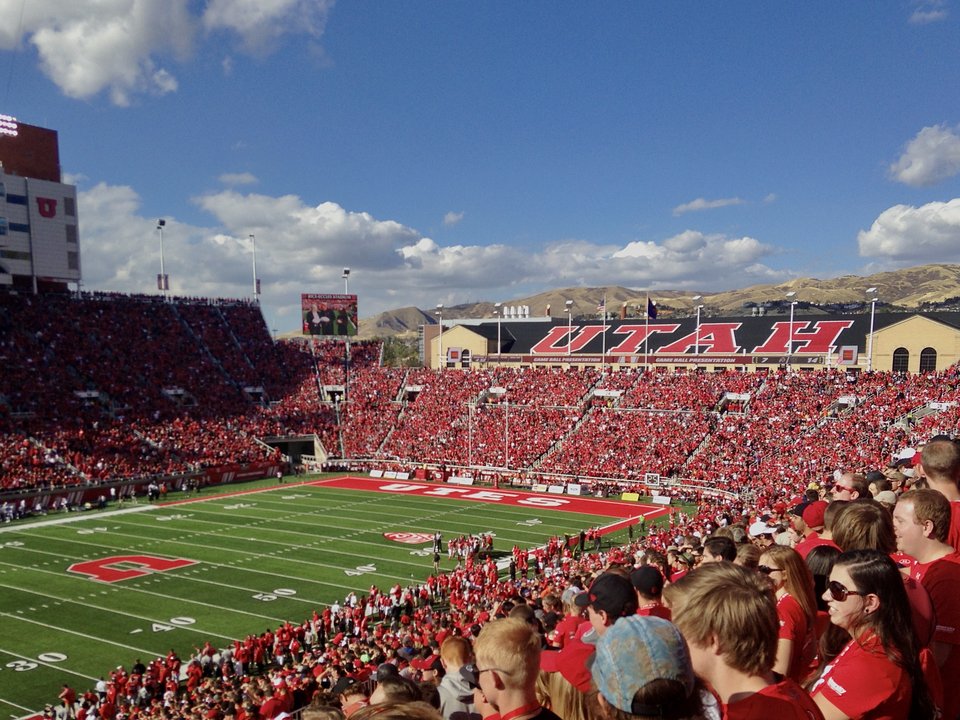
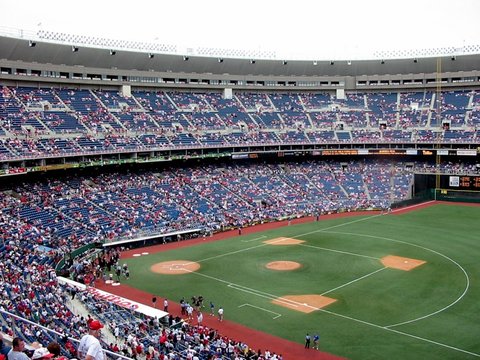
**Cover and caption.** Byarin photographed a Utah–Washington football game inside Rice–Eccles Stadium on October 29, 2016 and dedicated the image to the public domain under CC0 1.0. It shows the later successor bowl, not the Rolling Stones, the 1994 concert or Rice Stadium’s exact 1994 structure. [Image source and license](https://commons.wikimedia.org/wiki/File:Rice_Eccles_Stadium,_Salt_Lake_City,_Utah.jpg)
changes?
delete this memory?
We detected that you have a Blox in your crypto wallet! We will import the Blox into your account.
Click on done below to complete the import.
Welcome Back!
Sign in to preserve cherished moments
Don't have an account?
Welcome!!
Sign up and start preserving cherished moments
?
?
Choose your payment method
Buy with Metablox Credit
Do you want to mint Blox with Metablox Credit?
Which Crypto would you like to use?
Purchase Confirmed!
Your Blox is being minted on-chain and will appear in your profile shortly.
Log in or sign up to claim your Blox.
How many credits do you want to buy?
$100 USD = 1 Metablox Credit = 1 Blox.
Use Metablox Credit to mint any Blox you want on the map.
 expand_more