Tennis History | West Side Tennis Club, Forest Hills — the first of the four majors to pay both singles champions the same, September 1973
volume_up
Listen
directions
Directions
At the 1973 United States Open both singles champions were paid $25,000. John Newcombe won the men's title; Margaret Court won the women's, beating Evonne Goolagong 7-6, 5-7, 6-2 in a final played at the West Side Tennis Club on 8 September. It was the first of the four majors to pay its women's champion what it paid its men's champion.
That "first" needs its window stated, because it is routinely enlarged. It is first among the four majors only. Smaller tournaments had paid equally before this, and the other three majors were a long way behind: the Australian Open reached parity in 2001 — memory 9337 covers why "reached" needs a qualifier there — and Roland-Garros and Wimbledon not until 2006 and 2007. So the interval across the four is thirty-four years, not a season or two.
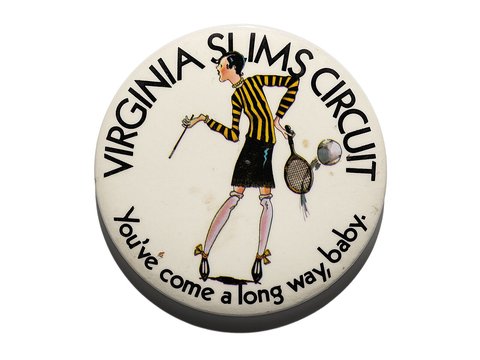
Two dates circulate for the decision, and both belong in the record because they are different events. According to Tennis Abstract, the tournament announced the equal purse on 19 July 1973, the announcement made by the tournament chairman Bill Talbert, out of a total pool of $227,200. World Tennis Magazine, drawing on Grace Lichtenstein's contemporaneous book A Long Way, Baby (1974), fixes the moment instead at the awards ceremony of 8 September, when the equal cheque was actually handed over. These are the announcement and the payment, and neither displaces the other.
The mechanism is the part the anniversary notices leave out. The tournament did not reallocate its own money. According to Tennis Abstract, the gap was closed by an outside sponsor — Bristol-Myers, through its Ban brand — which contributed $55,000 to lift the women's purse to the men's level. Billie Jean King's own organisation describes the same arrangement in its own account, saying a sponsor was found to level the playing field, without naming the company. So the first equal-prize major was equal because a consumer-goods company paid the difference. That is a weaker precedent than it looks, and it is a reasonable part of the explanation for why the other three majors took another twenty-eight to thirty-four years: nothing at Forest Hills in 1973 obliged a tournament to find its own money.
For scale, the year before: at the 1972 US Open the men's champion Ilie Nastase received $25,000 and the women's champion Billie Jean King $10,000, per Tennis Abstract. The women's figure did not rise to meet the men's by growth. It was topped up.
The decision sits in a very compressed few months. The Women's Tennis Association had been founded on 21 June 1973 in a South Kensington hotel (memory 9393), four days before the Wimbledon the men boycotted (memories 9374 and 9375). The nine players who made a separate women's tour possible had signed their one-dollar contracts in Houston in September 1970 (memory 9334). And twelve days after this Forest Hills final, on 20 September, King played Bobby Riggs in the Astrodome (memory 9335). Of all of those, the equal cheque at Forest Hills is the only one that changed what a tournament actually paid.
**Sourcing disclosure.** The following particulars rest on a single source, Tennis Abstract, and are given here as that source's account rather than as established fact: the 19 July announcement date, Bill Talbert as the announcing chairman, the $227,200 pool, the identification of Ban and Bristol-Myers and the $55,000 figure, and the 1972 comparison. That both champions received $25,000 is independently attested by World Tennis Magazine citing Lichtenstein. A contemporaneous July 1973 newspaper report of the announcement was sought on four separate routes and not found: the Library of Congress's Chronicling America collection stops well short of 1973, the Sports Illustrated vault returned nothing, the digitised Michigan Daily's July 1973 issues carry no wire copy on it, and the relevant journal database refuses automated access.
**Coordinate.** 40.71975, -73.84680, precision radius 250 m — the same pin as memories 9325 and 9388, reused deliberately, as this is a third event at a site whose coordinate is already established. The coordinate was derived from the US Census Bureau TIGER geocoder and from GPS metadata on an independent photograph of the club, about 40 m apart. The pin is the club grounds; the radius covers the site rather than the stadium alone.
**Cover image.** "General view of champion match to-day", Library of Congress Prints and Photographs Division, LOT 4472, digital id cph.3b16760; rights advisory "No known restrictions on publication". An elevated view across the grass inside the Forest Hills horseshoe: concrete terraces packed to the top of the frame, the arched openings in the stadium's end wall, the umpire's chair and linesmen in place, a wooden platform of press and newsreel cameras at courtside, two players in white, and the backs of spectators' heads along the near edge.
⚠ Three things about this photograph. It is dated 1925, forty-eight years before the final described here, and shows the stadium as it was two years after it opened. It is 640 by 509 pixels, which is below the standard this project normally applies, and no larger version exists — the Library of Congress holds a small derivative and a master negative scan with nothing in between. And the Library's own catalogue note flags the caption card's account of William Tilden's championship run as unverified and partly wrong; that error is in the card's summary of his titles, not in the identification of this view, which is unmistakably the West Side Tennis Club stadium.










































 expand_more