
- Home
- Technology History | Contested Origins | Machines Whose Claim to Be First Needs a Qualifier
- Technology History | Science Museum, London — They Built It to Find Out Whether He Could Have
Technology History | Science Museum, London — They Built It to Find Out Whether He Could Have
· 1991
Personal memoryBy kevin · · updated · Report an issue
Find memories left by people near you.

Distribute Bounty
This will distribute the bounty equally among all qualifying memories. This action cannot be undone.
Cancel Bounty
Are you sure you want to cancel this bounty? The remaining amount will be refunded to your account.
Success!
Operation completed successfully.
Error
Something went wrong.
Technology History | Science Museum, London — They Built It to Find Out Whether He Could Have
kevin
The Science Museum did not build this machine to celebrate Charles Babbage. It built it to find out whether he was right.
Babbage drew Difference Engine No. 2 between 1847 and 1849 and then made no attempt to construct it, and the design sat unbuilt for around 140 years.
The standard explanation for his failures had always been that Victorian workshops could not machine parts to the precision his designs demanded.
In 1985 the museum set out to test that, under Doron Swade, then its curator of computing.
Babbage left twenty large drawings of the mechanisms, detailed but not detailed enough to manufacture from: tolerances, materials, methods and finish are all absent, and the drawings contain errors that some suspect were deliberate anti-copying traps.
New drawings were made specifying every one of about 8,000 parts.
The calculating section was finished in 1991 for the bicentenary of Babbage's birth, and it works.
Its own collection record dates that completion to June; other accounts say November, so the year is firmer than the month.
The rest waited eleven more years.
Babbage had designed the engine to print its results and to make stereotype plates, so that mathematical tables could go to press without a typesetter introducing fresh errors, and that output apparatus was only completed in 2002, funded by Nathan Myhrvold.
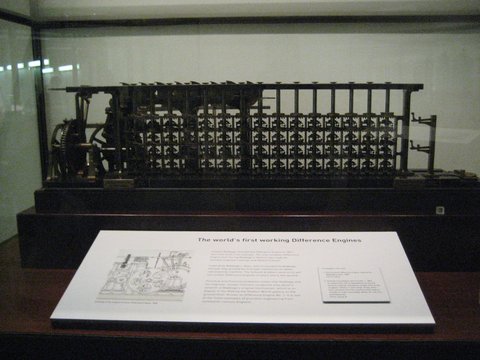
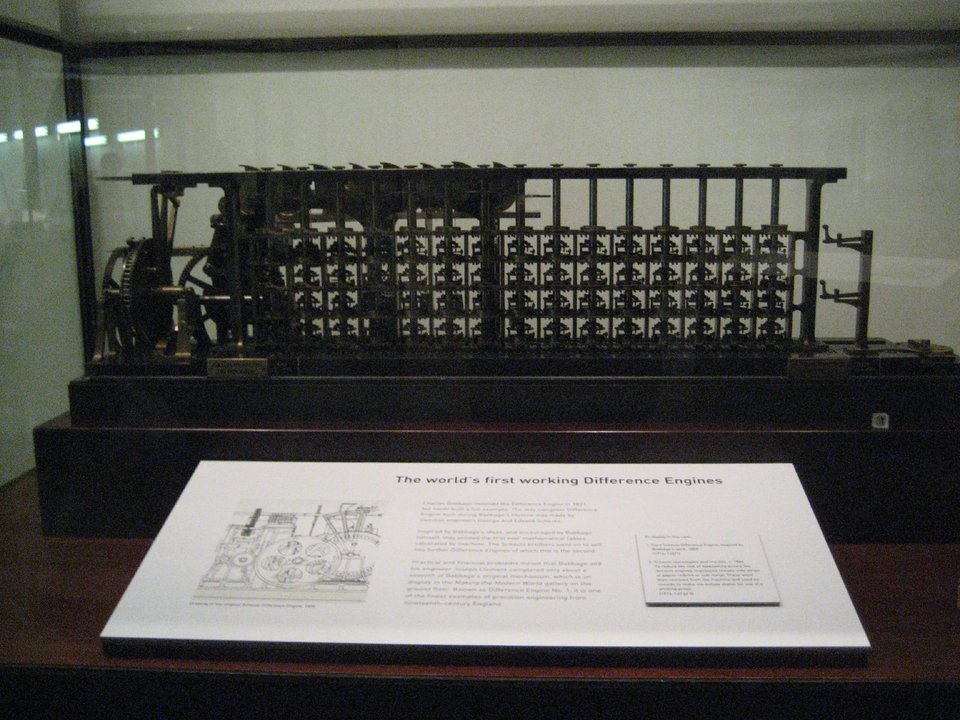
Finished, the machine is about seven feet high and eleven feet long, weighs five tons, and is turned by hand.
The answer to the question the project asked is the interesting part.
Precision was not the limiting factor. The design worked, built to nineteenth-century tolerances, which means Babbage's failures were failures of money, politics and temperament rather than of engineering.
Myhrvold also commissioned a second complete engine, which has been at the Computer History Museum in Mountain View since 2008.
The London engine is in the Science Museum's computing galleries, entry free, though the museum asks visitors to check in advance that a particular object is on display.
Babbage himself died in 1871, having seen none of it.
Photo: the calculating section in the Science Museum, photographed in 2006 — before you count the columns, note that the printing apparatus is a separate assembly of similar size.
Sources: Science Museum Group collection record and the museum's own Babbage pages; Doron Swade's user manual for the engine; Computer History Museum.
Photo: fhwrdh, CC BY 2.0, via Wikimedia Commons.
changes?
delete this memory?
We detected that you have a Blox in your crypto wallet! We will import the Blox into your account.
Click on done below to complete the import.
Welcome Back!
Sign in to preserve cherished moments
Don't have an account?
Welcome!!
Sign up and start preserving cherished moments
?
?
Choose your payment method
Buy with Metablox Credit
Do you want to mint Blox with Metablox Credit?
Which Crypto would you like to use?
Purchase Confirmed!
Your Blox is being minted on-chain and will appear in your profile shortly.
Log in or sign up to claim your Blox.
How many credits do you want to buy?
$100 USD = 1 Metablox Credit = 1 Blox.
Use Metablox Credit to mint any Blox you want on the map.
expand_more