- Home
- Technology History | Boelter Hall 3420 — The Room Nobody Could Find
Technology History | Boelter Hall 3420 — The Room Nobody Could Find
· 1969-10
Personal memoryBy kevin · · Report an issue
Find memories left by people near you.
Distribute Bounty
This will distribute the bounty equally among all qualifying memories. This action cannot be undone.
Cancel Bounty
Are you sure you want to cancel this bounty? The remaining amount will be refunded to your account.
Success!
Operation completed successfully.
Error
Something went wrong.
Technology History | Boelter Hall 3420 — The Room Nobody Could Find
kevin
For forty-two years nothing marked the room. Not a plaque, not a sign — an undergraduate teaching lab, in a building full of them.
Brad Fidler, then a doctoral candidate in the history of science at UCLA, went looking for it around 2010 and found that nobody agreed where it was. Some said North Campus, some said one engineering building, some another.
He narrowed it to a corridor, then to a door, using period photographs and the recollections of people who had worked there. The answer was Boelter Hall 3420.
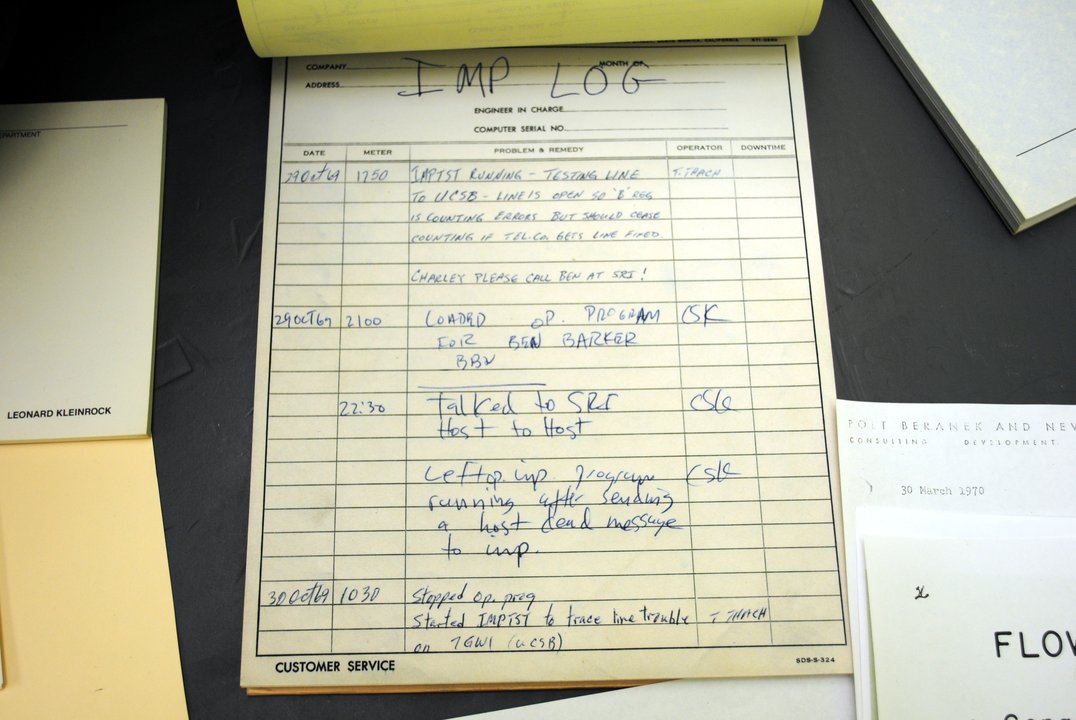
What happened in it: on 29 October 1969, a graduate student named Charley Kline sat at a terminal connected to an Interface Message Processor, the refrigerator-sized machine that did the packet routing, and tried to log in to a computer at the Stanford Research Institute in Menlo Park.
He typed L, then O. Then SRI's machine crashed, which is how the first message sent over the ARPANET came to be the word "lo".
Leonard Kleinrock, whose mathematical work on packet networks underpinned the whole thing, was in the room. Bill Duvall was at the other end. About an hour later they tried again and it worked.
The log in the photograph records it in the flattest language imaginable: at 22:30, "Talked to SRI Host to Host." The entry above it, from earlier that evening, reads "Charley please call Ben at SRI!"
Three people were on the network that day.
Say ARPANET rather than internet and the claim stays true. This was the first host-to-host message on the network that became the internet, which is a narrower and better-documented thing than being the internet's birthplace, whatever the campus signage says.
The room reopened in 2011 as the Leonard Kleinrock Internet Heritage Site and Archive, restored to something like its 1969 state, with an IMP in it and a reproduction of the log. Kleinrock donated his papers first; others followed.
It is a working part of a working campus rather than a museum with opening hours. UCLA runs occasional tours, sometimes led by Kleinrock himself, and those are the reliable way in.
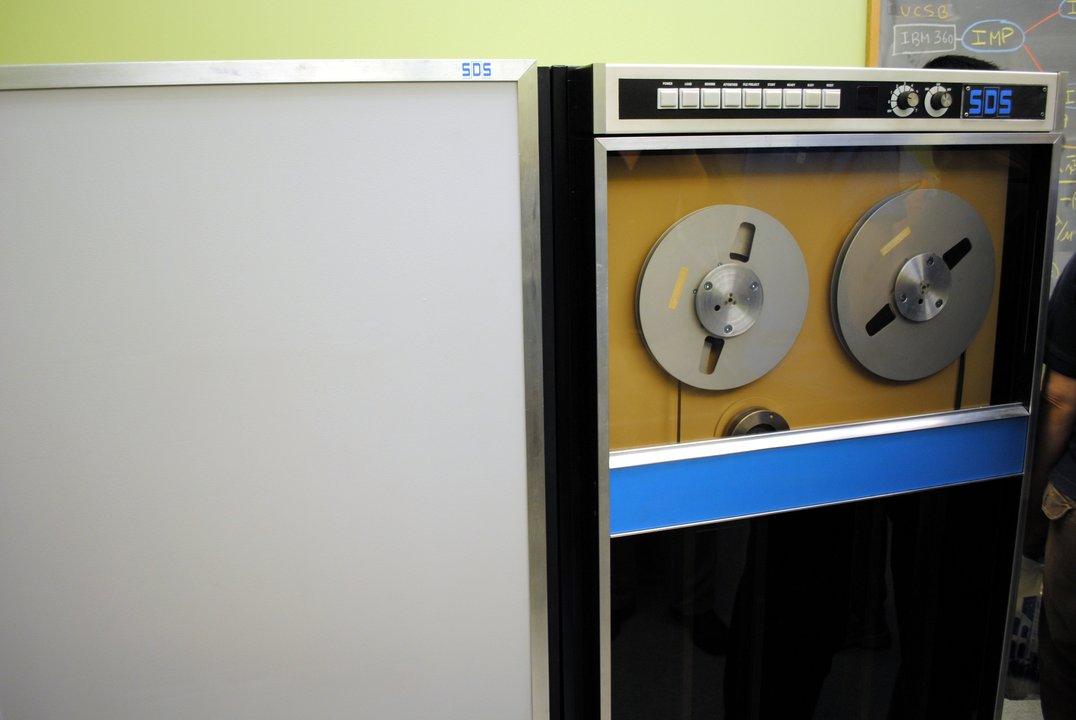
The second photograph shows the SDS Sigma-7, the host computer the IMP was attached to, with the lab blackboard behind it still listing the early nodes.
Sources: UCLA Samueli School of Engineering on the heritage site and the 2011 opening; Daily Bruin, 2011, on Fidler's search for the room; UCLA Connection Lab and the Fowler Museum on the log entry. Cover photo and second image: Andrew "FastLizard4" Adams, CC BY-SA 2.0, via Wikimedia Commons, both taken in the room in 2011.
changes?
delete this memory?
We detected that you have a Blox in your crypto wallet! We will import the Blox into your account.
Click on done below to complete the import.
Welcome Back!
Sign in to preserve cherished moments
Don't have an account?
Welcome!!
Sign up and start preserving cherished moments
?
?
Choose your payment method
Buy with Metablox Credit
Do you want to mint Blox with Metablox Credit?
Which Crypto would you like to use?
Purchase Confirmed!
Your Blox is being minted on-chain and will appear in your profile shortly.
Log in or sign up to claim your Blox.
How many credits do you want to buy?
$100 USD = 1 Metablox Credit = 1 Blox.
Use Metablox Credit to mint any Blox you want on the map.
expand_more