- Home
- Technology History | Asia's Computer Districts | Zhongguancun, Akihabara and Guanghua
- Technology History | Akihabara, Tokyo — Four Changes of Stock, One Unchanged Function
Technology History | Akihabara, Tokyo — Four Changes of Stock, One Unchanged Function
· 1951
Personal memoryBy kevin · · Report an issue
Find memories left by people near you.

Distribute Bounty
This will distribute the bounty equally among all qualifying memories. This action cannot be undone.
Cancel Bounty
Are you sure you want to cancel this bounty? The remaining amount will be refunded to your account.
Success!
Operation completed successfully.
Error
Something went wrong.
Technology History | Akihabara, Tokyo — Four Changes of Stock, One Unchanged Function
kevin
The district is named after a fire, or rather after the shrine built to stop one.
After a fire in the late 1860s the area was cleared as a firebreak and a shrine to Akiba Daigongen was placed on it, and when the railway station opened in 1890 it took the name Akihabara.
Then Tokyo burned properly. The 1945 air raids left this part of Kanda in ashes, and what grew back was a black market.
Students from the electrical engineering school that is now Tokyo Denki University assembled simple radios from components, a good deal of it surplus that flowed out of the occupation, and sold them from stalls near the tracks. Retailers came from across Japan to buy cheap sets.
Over the late 1940s and early 1950s the stalls were pushed off the street and into buildings, and the trade turned legitimate. The name 電気街, Electric Town, dates from roughly then.
What Akihabara sold next was the Japanese economic miracle in physical form. Through the 1960s and 1970s the shops filled with washing machines, refrigerators, televisions and stereos, and the district became the country's main retail floor for them.
The turn came in the 1980s, when household appliances stopped feeling like the future. Shops moved into home computers at a point when computers were still for hobbyists and specialists, and by the 1990s computer equipment had overtaken appliances here.
That switch brought a different customer, and the district followed him too. Computer hobbyists overlapped heavily with anime, manga and game fans, and after the mid-1990s the shelves filled with figures, models and character goods.
So the honest description is not that Akihabara is an electronics district that became an otaku district. It has changed its stock four times in eighty years while never changing its actual function, which is to sell enthusiasts the specific thing they cannot buy conveniently anywhere else.
The oldest layer is still trading. The multi-storey parts markets near the Electric Town exit sell connectors, switches, vacuum tubes and wire by the metre, floor after floor of small stalls, and they are the direct descendants of the students under the tracks.
This pin is the station's Electric Town exit, because the subject here is a district rather than a building.
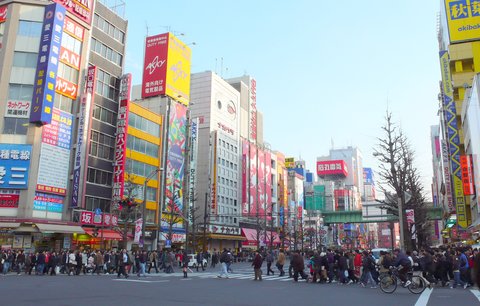
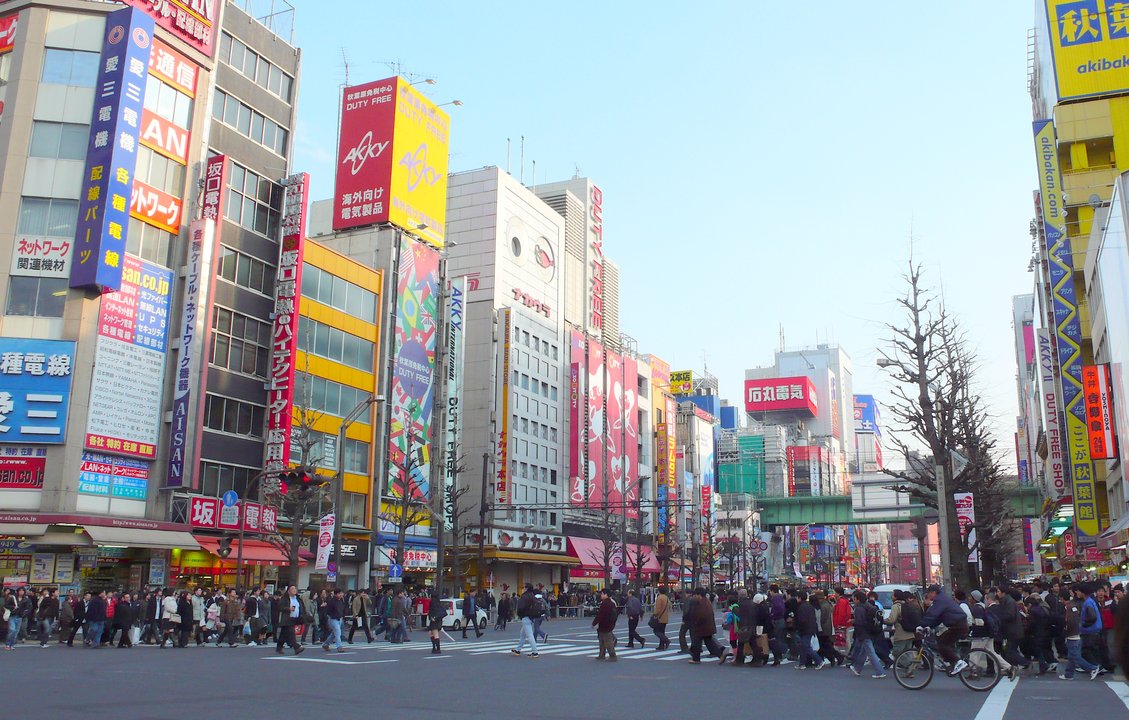
Cover: photo by Jmho, CC0, via Wikimedia Commons. It was taken in 2007 and shows the Chuo-dori crossing during the electronics-and-duty-free era, before the most recent turn in what the signage advertises.
changes?
delete this memory?
We detected that you have a Blox in your crypto wallet! We will import the Blox into your account.
Click on done below to complete the import.
Welcome Back!
Sign in to preserve cherished moments
Don't have an account?
Welcome!!
Sign up and start preserving cherished moments
?
?
Choose your payment method
Buy with Metablox Credit
Do you want to mint Blox with Metablox Credit?
Which Crypto would you like to use?
Purchase Confirmed!
Your Blox is being minted on-chain and will appear in your profile shortly.
Log in or sign up to claim your Blox.
How many credits do you want to buy?
$100 USD = 1 Metablox Credit = 1 Blox.
Use Metablox Credit to mint any Blox you want on the map.
expand_more