Semiconductor History | RCA 桃園廠 — The Wells Behind the Television Factory
volume_up
Listen
directions
Directions
On 1 June 1994 a legislator held a press conference in Taipei and said that an American electronics company had spent two decades digging wells at its Taoyuan plant and pouring solvent waste into them.
The environment agency commissioned an investigation the following day.
The plant had already closed, in October 1992, and been sold to a developer who wanted the land rezoned for housing and shops.
RCA arrived in Taoyuan in 1969 and built a 7.2-hectare works on the boundary between what are now 桃園區 and 八德區, making televisions and electronic components.
Ownership passed to General Electric in 1986 and to the French company Thomson in 1988, which is why four corporate names appear in the litigation rather than one.
The solvents were trichloroethylene, tetrachloroethylene and the compounds they break down into.
Workers used them as cleaning fluid, wiping benches and washing work clothes, because nobody had told them that the effective degreaser they had been handed was a carcinogen. Former employees have described this in their own words, and one has said publicly that she wonders whether she was also, unknowingly, part of the harm.
Most of the workforce were young women.
The drinking fountains on the production line drew groundwater rather than mains water, and so did the dormitories outside the gate.
By the counts used in the court proceedings, more than a thousand former employees developed cancer and hundreds have died.
Taiwan's environment agency declared the works a groundwater remediation site on 19 March 2004, and designated about 50 hectares around it a groundwater control zone on 19 August 2005, banning use of the groundwater inside it.
Soil remediation finished in 1998. Groundwater remediation ran for another quarter of a century across four revised plans, at a cost the government puts in the billions of New Taiwan dollars.
Verification sampling of all 167 wells, in the wet season of November 2024 and the dry season of March 2025, came back below the control standard, and the city approved a completion report at the end of 2025.
Delisting has not happened. A further two-season verification is running, and the monitoring wells still stand on the ground.
The legal record is longer still, and it is also not closed.
Former workers organised a self-help association in 1998; a first-instance judgment came in 2015, the High Court ruled in 2017, and in 2018 the Supreme Court confirmed damages of more than NT$500 million to 262 workers and families, the largest occupational-injury award in Taiwan's judicial history, while remanding 246 further claims. In January 2025 the High Court awarded a further NT$170 million to 222 people.
The courts pierced the corporate veil, holding RCA, General Electric, Technicolor and Thomson jointly liable.
This company appears twice in this collection. The same RCA signed the 1976 technology-transfer contract that sent nineteen engineers from 工研院 to train in the United States and gave Taiwan an integrated circuit industry.
Both things are true, and they happened in the same country in the same decade.
Former employees have asked that the ground, once remediation is signed off, become a park and education centre about occupational injury, and they have nominated the site as cultural heritage.
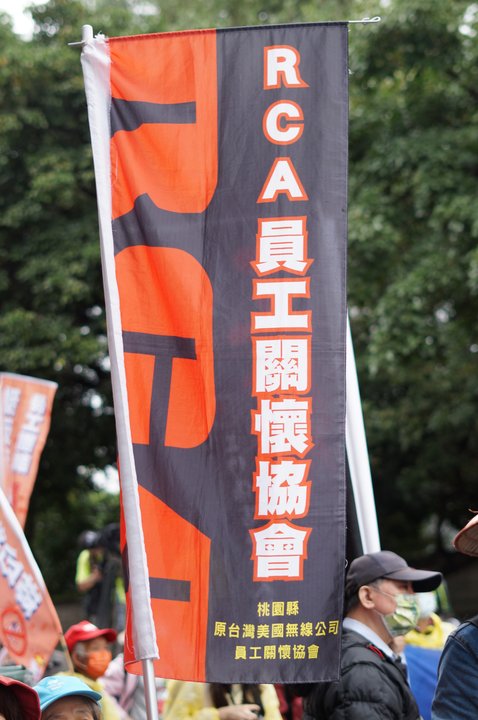
Photo: Solomon203, CC BY-SA 4.0, via Wikimedia Commons — a banner of the former employees' association, 桃園縣原台灣美國無線電公司員工關懷協會, carried at a demonstration in December 2021. It is not a photograph of the plant site.
















































 expand_more