Finance History | Berkshire’s Johnson & Johnson Stake
volume_up
Listen
directions
Directions
On 31 December 2010, Berkshire Hathaway’s year-end portfolio table recorded 45,022,563 Johnson & Johnson shares, representing 1.6% of the healthcare company, with an aggregate cost of US$2.749 billion and a market value of US$2.785 billion.
The position was not a controlling investment, yet its scale placed a diversified healthcare enterprise inside the group of marketable securities that Warren Buffett discussed as operating businesses viewed through fractional ownership.
Johnson & Johnson’s 2010 annual report organized the company around Consumer, Pharmaceutical, and Medical Devices and Diagnostics activities, a structure that spread demand across everyday products, prescription therapies, surgery, diagnostics, vision care, orthopaedics, and other clinical markets.
That breadth offered several possible economic attractions for a long-term investor: recurring demand, recognizable products, extensive distribution, research pipelines, and businesses whose value depended more on durable customer and professional relationships than on physical inventory alone.
The year also illustrated why apparent stability could not remove operating risk, because Johnson & Johnson reported that Consumer sales were hurt by McNeil product recalls while medical-device franchises faced procedure slowdowns, pricing pressure, and intense competition.
Berkshire’s figures therefore capture a moment when a strong franchise could still be tested by manufacturing quality, regulation, patents, product liability, and the need to replenish innovation across several very different markets.
The gap between Berkshire’s stated cost and year-end market value was only about US$36 million, making this holding unlike positions whose quoted value had multiplied many times over their tax basis.
Buffett’s accompanying explanation stressed that the cost column represented actual purchase price and tax basis, while the economic case also included Berkshire’s share of earnings retained by investees rather than immediately distributed as dividends.
That framing matters because a healthcare company can reinvest internally through research, manufacturing, acquisitions, and market development, but those retained dollars create value only when they produce future cash flows above the capital required and the risks assumed.
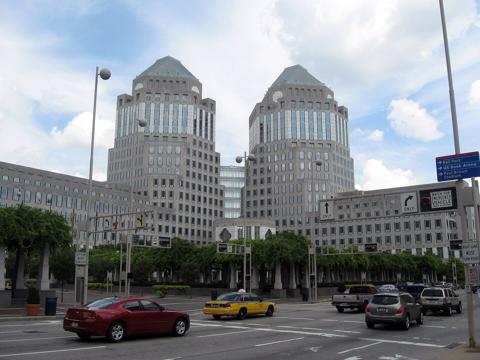
The mapped headquarters photograph in New Brunswick is a public exterior anchor for the enterprise, not a claim that Berkshire bought shares at this building or on this date.
As a financial-history memory, the position shows Berkshire applying its owner-oriented lens to a complex regulated business: count the shares, compare cost with market value, understand the underlying engines, and keep operational vulnerabilities visible beside brand strength.
**Sources:** Berkshire Hathaway 2010 annual report and shareholder letter; Berkshire Hathaway Form 13F-HR for the quarter ended 31 December 2010; Johnson & Johnson 2010 annual report.
**Image:** “JohnsonJohnson HQ building.jpg,” Ekem, January 2006, public domain, Wikimedia Commons.







































































 expand_more