Finance History | Rialto, 11 April 1587 — Venice Made Ledger Transfer a Civic Service
volume_up
Listen
directions
Directions
On 11 April 1587, the Venetian Senate approved the Banco della Piazza di Rialto, creating a publicly authorized deposit bank beside the city’s principal commercial market.
The measure answered a practical crisis because failures among private bankers had disrupted payments and weakened confidence in deposits used by merchants.
The new bank accepted coin, credited depositors on its books, and transferred balances between accounts by written entry, known in Venice as payment by scritta.
That service mattered in a market where many coins circulated with different weights, metallic contents, and exchange values.
Instead of carrying specie from one counterparty to another, merchants could instruct the bank to debit one account and credit another in a standardized unit.
The institution combined public oversight with delegated management, since a governor operated it under rules, security requirements, and the guarantee of the Venetian state.
Convertibility remained central to confidence because depositors expected their recorded balances to be available in accepted coin when demanded.
The bank therefore offered settlement infrastructure rather than the full range of lending and investment associated with a modern commercial bank.
Its books supplied a common payment layer for bills, wholesale trade, public revenue, and obligations crossing the dense merchant networks of the Rialto.
Risks remained, while public authorization shifted payment reliability away from a succession of lightly supervised private banks toward an institution whose rules and standing were visible to the republic.
The Banco della Piazza di Rialto operated until 1637 and should not be confused with the Banco del Giro, a later Venetian public bank created during the seventeenth century.
Its significance lies in treating dependable book transfer as a civic utility for commerce, backed by the authority of a trading state.
The wealth moving through Venetian markets also came from imperial privileges, maritime conflict, and unequal trading relationships, so the efficiency of the ledger served a political economy extending far beyond the square.
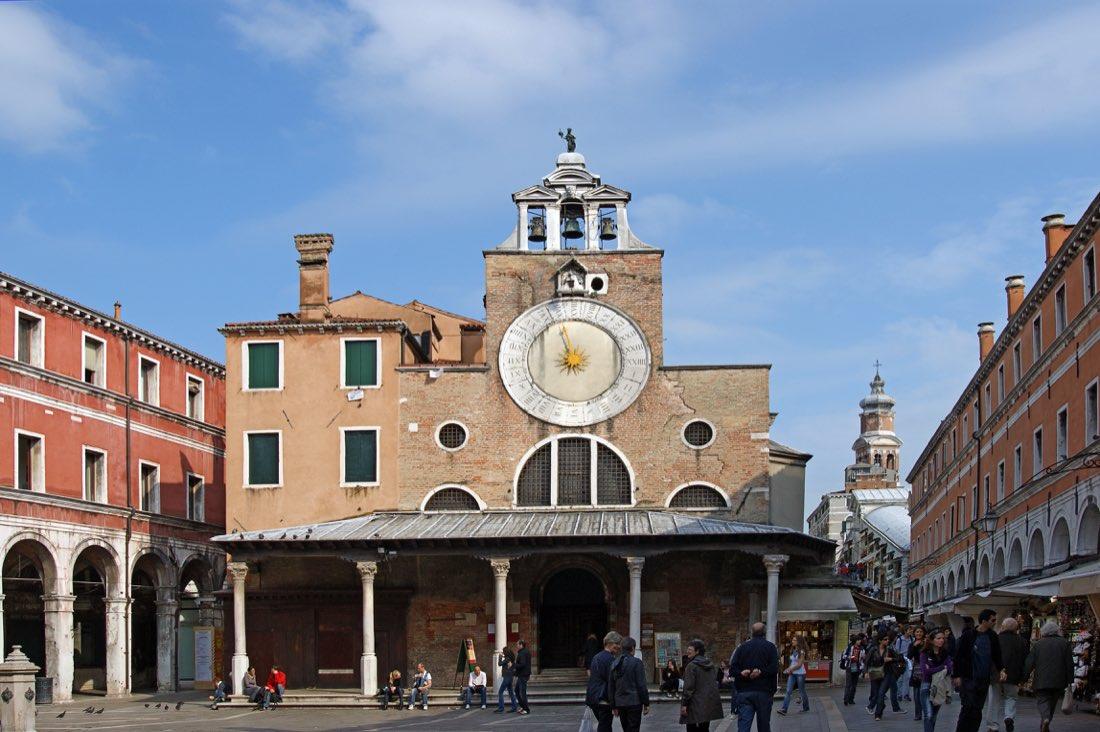
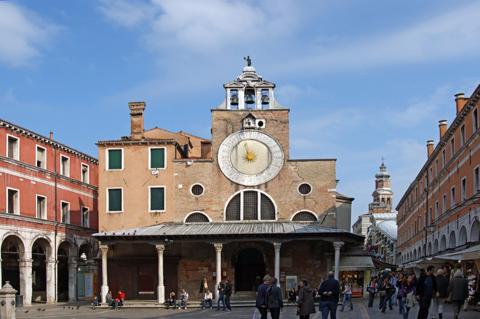
The pin marks Campo San Giacomo di Rialto and the portico associated with the banking market, while the image shows the church façade and surviving public space at that location.
Photo: Didier Descouens, CC BY-SA 4.0, via Wikimedia Commons.















 expand_more