Finance History | Bear Stearns, 245 Park Avenue, New York, 21 September 1998 — The Clearing Agent Asked for $500 Million More
volume_up
Listen
directions
Directions
Bear Stearns cleared nearly all of Long-Term Capital Management's trades, which meant it could see the fund's cash position before anyone else could.
A prime broker holds a fund's securities, keeps its records, settles its trades and lends it money. It also advances intraday credit so that payments clear during the day, and it stands behind the fund's futures positions at the exchanges.
That arrangement gives one firm the earliest warning and the shortest path to the exit.
By 21 September 1998 Bear Stearns had stopped extending intraday clearing credit to LTCM and was requiring the fund to post collateral against potential settlement exposures. It wanted around $500 million more to keep clearing, and it was prepared to stop.
LTCM had ended August with $2.3 billion of capital and was still losing money through September.
Here is the mechanism that makes a clearing relationship dangerous to both sides. Collateral demanded to protect one firm removes the liquidity the fund needs to survive, so each prudent call raises the probability of the default that the collateral was meant to guard against.
Reviewing the episode the following January, the Basle Committee put the blame further upstream, finding that heavy reliance on collateralising current exposures had let banks neglect due diligence, exposure measurement and limit setting.
Two days later, at the Federal Reserve Bank of New York, Bear Stearns declined to contribute to the rescue, on the grounds that it already carried enough exposure as clearing agent.
It is usually remembered as the only firm that refused. It was not.
Lehman Brothers also declined, and the Federal Reserve's own account of the episode records two firms in the talks declining to take part. The fourteen that agreed put up $3.625 billion between them: eleven at $300 million each, Société Générale at $125 million, Crédit Agricole and Paribas at $100 million each.
Whether Bear Stearns was right is a question people still argue about, and the argument is not settled by what happened afterwards.
In March 2008 the firm ran short of cash in a matter of days, and the Federal Reserve backed its sale to JPMorgan Chase. That rescue did use public money, which the 1998 one had not.
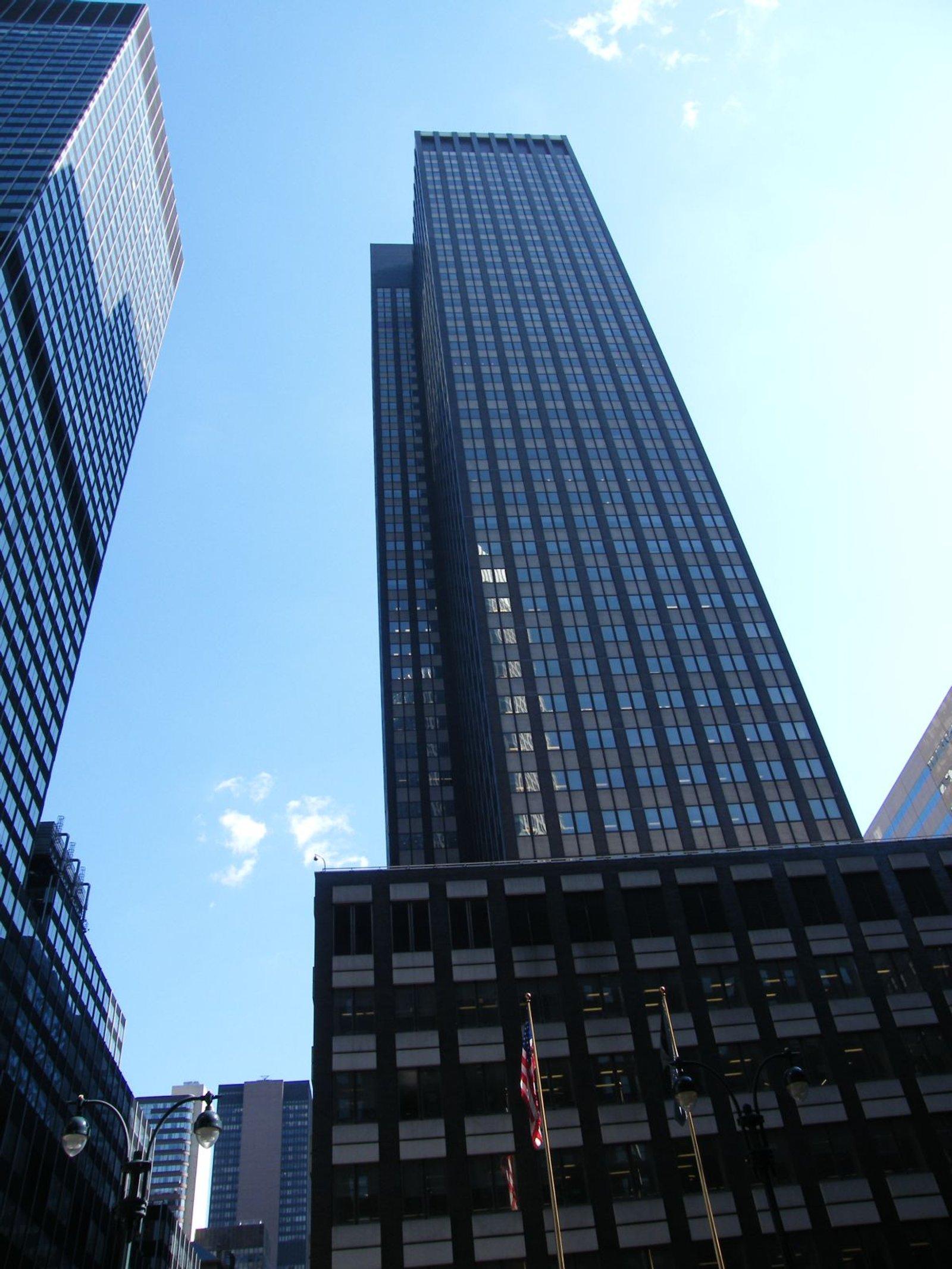
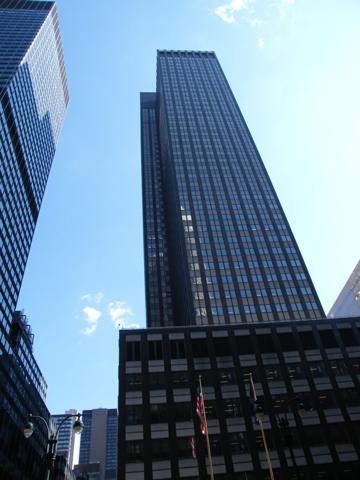
The tower here has 48 storeys and opened in 1967, designed by Shreve, Lamb and Harmon Associates, on the block bounded by Park Avenue, Lexington Avenue and East 46th and 47th Streets. Bear Stearns left for 383 Madison Avenue in the early 2000s.
The photograph dates from October 2008, five months after the sale. Its podium is currently being re-clad along the Park Avenue front, so the base of the building no longer looks like this, while the tower above is unchanged.
Photo: Americasroof, CC BY-SA 3.0, via Wikimedia Commons.









 expand_more