


Dynastic History|Borobudur — A Million Stones Put Back
· 1983-2
Personal memoryBy kevin · · Report an issue









.jpg/1600px-Isle_of_Skye_-_Neist_Point_Lighthouse_at_sunset_(50666980882).jpg)




























Find memories left by people near you.
Distribute Bounty
This will distribute the bounty equally among all qualifying memories. This action cannot be undone.
Cancel Bounty
Are you sure you want to cancel this bounty? The remaining amount will be refunded to your account.
Success!
Operation completed successfully.
Error
Something went wrong.
Dynastic History|Borobudur — A Million Stones Put Back
kevin
On 23 February 1983 the president of Indonesia and Amadou-Mahtar M'Bow, director-general of UNESCO, attended a ceremony on the Kedu plain marking the end of the restoration campaign the Indonesian government and UNESCO had run since the mid-1970s. A United Press International dispatch filed the day before gave the arithmetic: roughly a million stones taken down, treated and catalogued by computer over more than eight years, about 700 workers on the site, and 6.5 million dollars raised through UNESCO from twenty-eight countries towards a project the same dispatch put at 24 million dollars overall.
No inscription records who ordered the monument built, or when. It is assigned to the Śailendra rulers of the eighth and ninth centuries on architectural and epigraphic grounds. The nearest documents are two charters from the Kedu plain: Karangtengah, of 824, which names a sacred building called Jinalaya inaugurated by Pramodhawardhani, and Tri Tepusan, of 842, recording sīma, tax-free land, granted by Śrī Kahulunan for the upkeep of a kamūlān named Bhūmisambhāra. De Casparis's identification of that name with Borobudur is an argument, widely accepted, not a record; even Kahulunan's title is translated by different scholars as queen consort and as queen mother. What the 842 charter does show is how a monument of this size was kept standing: the dues of named villages, permanently diverted to it.
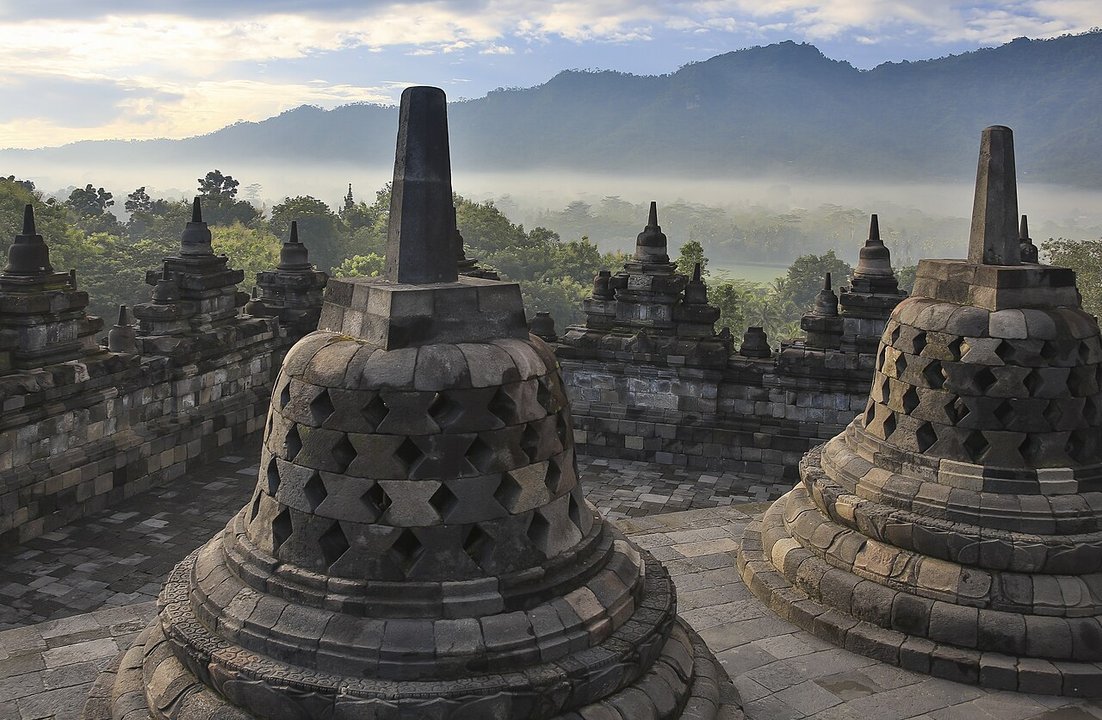
What visitors climb today is largely a twentieth-century reassembly. Theodoor van Erp, a Dutch army engineer, rebuilt the upper terraces between 1907 and 1911, then dismantled the tiered parasol he had reconstructed on the summit stupa because too few original stones supported it; the pinnacle's design remains unknown. The campaign of 1975 to 1982 took the square platforms apart again to lay drainage. UNESCO listed the compounds in 1991.
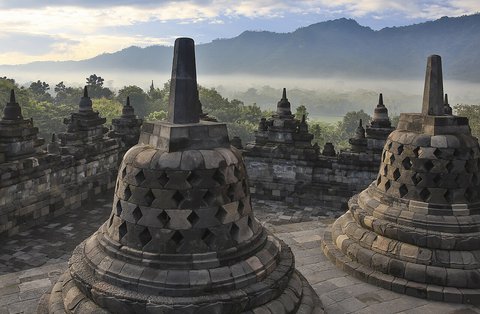
📸 Cover: stupas on the upper terrace, as reassembled in the twentieth-century restorations, CEphoto, Uwe Aranas, CC BY-SA 3.0 via Wikimedia Commons
changes?
delete this memory?
We detected that you have a Blox in your crypto wallet! We will import the Blox into your account.
Click on done below to complete the import.
Welcome Back!
Sign in to preserve cherished moments
Don't have an account?
Welcome!!
Sign up and start preserving cherished moments
?
?
Choose your payment method
Buy with Metablox Credit
Do you want to mint Blox with Metablox Credit?
Which Crypto would you like to use?
Purchase Confirmed!
Your Blox is being minted on-chain and will appear in your profile shortly.
Log in or sign up to claim your Blox.
How many credits do you want to buy?
$100 USD = 1 Metablox Credit = 1 Blox.
Use Metablox Credit to mint any Blox you want on the map.
 expand_more