Finance History | 大稻埕碼頭 Dadaocheng Wharf, Taipei, 1869 — Tea Sold on Credit Before It Was Planted
volume_up
Listen
directions
Directions
The tea that made this district rich was paid for before it was grown.
John Dodd, a Scottish merchant, first came to Taiwan in 1860 and settled at Tamsui in 1864. Looking for camphor in the hills of the north, he noticed that the soil and climate resembled the tea country across the strait in Fujian.
His answer to the obvious problem, that no local farmer was going to gamble a season on an unfamiliar crop, was credit. He imported oolong seedlings from Anxi and sold them to growers on terms, with planting advice thrown in.
That is the whole district in one sentence. A farmer who could not afford to plant could plant anyway and settle out of the crop, so the capital arrived first, the tea second and the money third.
His comprador was 李春生, born in Xiamen in 1838, who had worked in the tea trade for a British firm there from 1857 and was recommended across. He handled the dealings between Dodd and Chinese growers, brokers and officials, and ended up one of the wealthiest men in Taipei.
There is a London thread running through this. Dodd had been working for Dent and Company, and Dent was brought down in 1867 in the wreckage of the Overend Gurney failure in Lombard Street the year before — the same crash that gave Walter Bagehot the material for his central-banking doctrine.
Dodd traded on his own account afterwards. He had meant to base the business at 艋舺, but the merchants and residents there obstructed foreign firms letting premises in 1867 and 1868, so he moved north to 大稻埕 and built his refining works here instead.
In 1869 he loaded about 2,131 piculs of tea, roughly 130 tonnes, onto two ships and sent it straight to New York under the brand Formosa Oolong, bypassing the Fujian middlemen entirely.
A figure of 213 tonnes circulates for that shipment and does not survive a check against the picul count. Exports the following year were around 10,540 piculs, and by the 1890s Taiwan was shipping close to ten thousand tons of oolong a year.
Everything went out through this waterfront. Crates were stacked on the dock only as long as it took to get them aboard, and for a stretch of the late nineteenth century Dadaocheng handled more tea than any other port on the island.
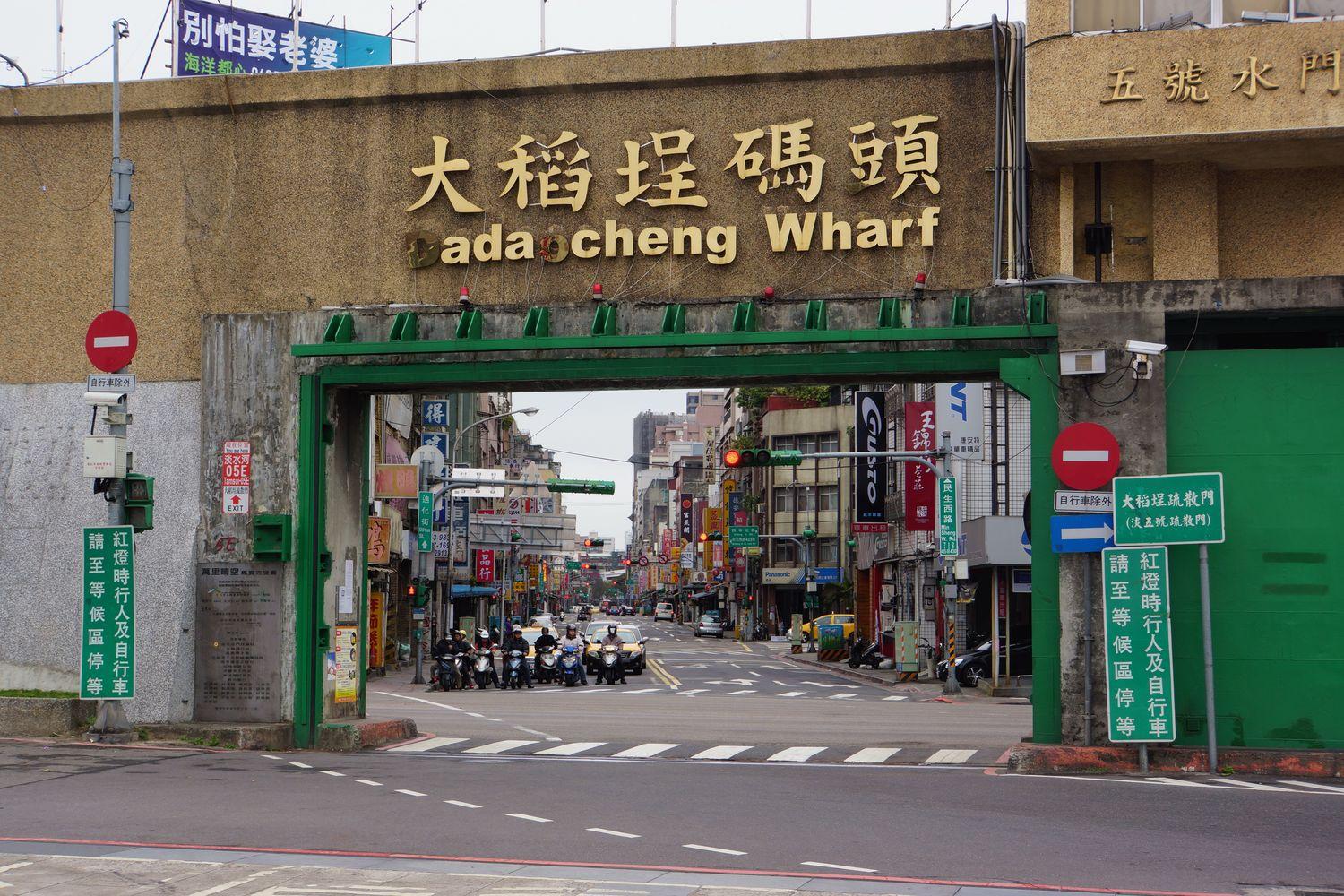
The Tamsui river silted, the trade moved, and the quay is now a promenade behind a flood wall. Watergate No. 5 in the cover photograph is the gap in that wall, and walking through it from the river puts you on the streets the tea money built.
Cover photo: lienyuan lee, CC BY 3.0, via Wikimedia Commons.
Coordinates 25.056620, 121.507830, resolved by Nominatim for 大稻埕碼頭 and agreeing with Commons geotags on the waterfront to within about 30 m.





 expand_more