Finance History | Eisenhower Executive Office Building, 12 November 1999 — One Corporate Umbrella Could Hold Banks, Brokers and Insurers
volume_up
Listen
directions
Directions
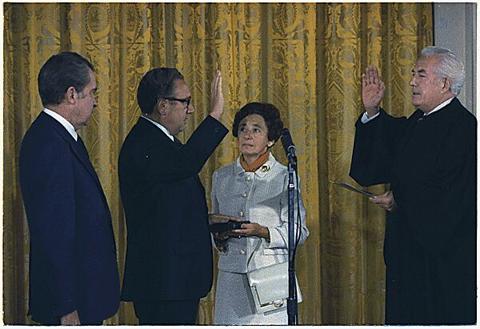
On 12 November 1999, President Bill Clinton signed the Gramm-Leach-Bliley Act in Presidential Hall at the Eisenhower Executive Office Building. The law rewrote federal rules governing whether commercial banks, securities firms, and insurance businesses could belong to the same corporate group.
The Banking Act of 1933 had separated important parts of commercial and investment banking, while later regulation and market practice had already opened limited routes around that wall. By the late 1990s, consolidation and the Citicorp–Travelers combination made the gap between formal restrictions and financial integration difficult to ignore.
Gramm-Leach-Bliley repealed large portions of the Glass-Steagall affiliation limits and amended the Bank Holding Company Act. It created the financial holding company, an umbrella organization permitted to own subsidiaries engaged in banking, securities underwriting and dealing, and insurance activities.
The mechanism was organizational rather than a simple license for every activity inside a bank. Deposit-taking institutions still faced restrictions, but a qualifying holding company could place different financial businesses in separate subsidiaries under common ownership.
Integration promised economies of scope: one group could distribute more products, use shared capital and customer relationships, and compete across markets that had previously been divided by legal form. It also created potential conflicts, operational complexity, and channels through which distress in one affiliate could affect confidence in another.
The law therefore paired permission with oversight. The Federal Reserve became the umbrella supervisor of financial holding companies, while functional regulators continued supervising securities, insurance, and banking entities within the group.
Gramm-Leach-Bliley also established rules for handling consumers’ nonpublic personal information and allowed customers in some circumstances to opt out of sharing with unaffiliated third parties. Those provisions made data governance part of the bargain that accompanied broader financial combination.
The act should not be treated as a one-line cause of the 2008 crisis; securitization, leverage, mortgage underwriting, derivatives, and shadow banking followed distinct rules and histories. Its durable significance is narrower and clearer: in Presidential Hall, the United States accepted the diversified financial group as a central legal form and built a new supervisory framework around it.
Image: video still from “Signing of the Financial Modernization Bill,” White House Television Office / U.S. National Archives, public domain, via Wikimedia Commons.



















 expand_more