
- Home
- Semiconductor History | Korea | Samsung from Suwon to Pyeongtaek, with Tokyo and San Francisco
- Semiconductor History | 수원, 1969 — The Television Factory That Turned Into a Memory Company
Semiconductor History | 수원, 1969 — The Television Factory That Turned Into a Memory Company
· 1969-1
Personal memoryBy kevin · · updated · Report an issue

Find memories left by people near you.
Distribute Bounty
This will distribute the bounty equally among all qualifying memories. This action cannot be undone.
Cancel Bounty
Are you sure you want to cancel this bounty? The remaining amount will be refunded to your account.
Success!
Operation completed successfully.
Error
Something went wrong.
Semiconductor History | 수원, 1969 — The Television Factory That Turned Into a Memory Company
kevin
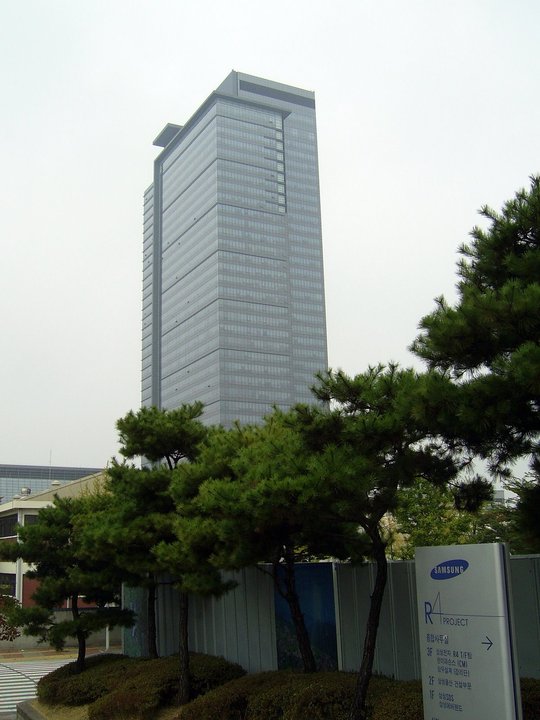
Samsung Electronics began by making black-and-white televisions in Suwon.
The company was incorporated on 13 January 1969 as 삼성전자공업, Samsung Electric Industries, in the year the Korean government passed a law to promote an electronics industry it did not yet have, and it did not take its present name until 1988.
Chips were not the founding idea. They were bought.
In December 1974 Samsung took a stake in 한국반도체, Hankook Semiconductor, a struggling wafer plant in Bucheon that was Korea's first, and the two dates get confused constantly: 1974 is when Samsung acquired a semiconductor business, 1983 is when it decided to bet the company on memory.
That second decision was announced from Tokyo on 8 February 1983 by 이병철, the founder, and it was not obviously sane at the time.
Korea had no DRAM industry, the incumbents were American and Japanese, and the product was a commodity whose price collapsed on a cycle.
The fabs did not go to Suwon.
They went to 기흥, Giheung, about ten kilometres southeast, where the first line was put up across the winter of 1983 and 1984 in roughly six months, and later to Hwaseong; Suwon kept the head office and the laboratories.
That division has held for forty years and it shapes what a visitor can actually see.
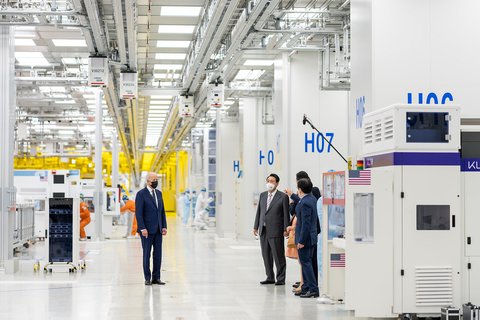
Giheung and Hwaseong are working fabs with no public face — a search of freely licensed photography within a kilometre and a half of the Giheung campus returns a reservoir, a footbridge and a Covid testing station, and nothing of the plant itself.
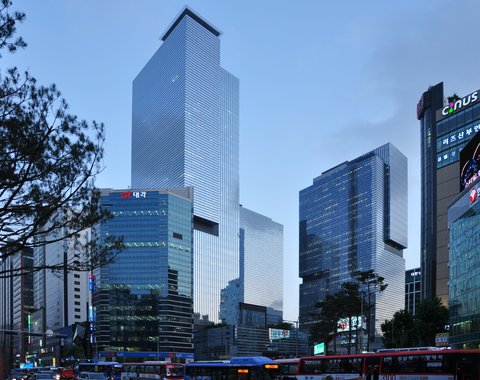
Suwon, by contrast, is a campus of more than a hundred buildings and some thirty-seven thousand staff, with research institutes numbered R1 to R5, the first of them dating from 1980.
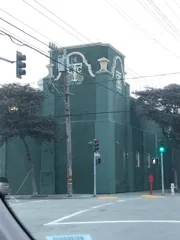
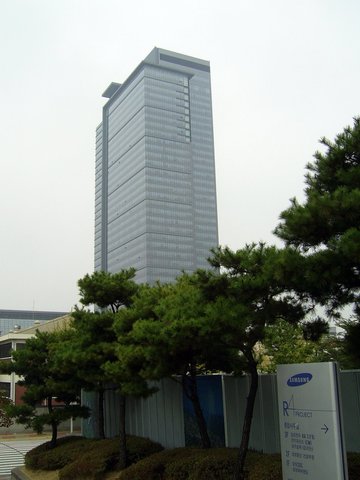
The photograph shows one of those research towers in January 2004, behind a hoarding and a site board for the R4 project, which is what corporate history looks like while it is still being poured.
On 21 April 2014 Samsung opened the Samsung Innovation Museum on the same campus, about ten thousand square metres over several floors, running from early electrical apparatus to its own products.
It is the one door in this story that opens, and the fabs it describes are the ones down the road that do not.
Photo: Grzegorz Sokol, CC BY 3.0, via Wikimedia Commons.
changes?
delete this memory?
We detected that you have a Blox in your crypto wallet! We will import the Blox into your account.
Click on done below to complete the import.
Welcome Back!
Sign in to preserve cherished moments
Don't have an account?
Welcome!!
Sign up and start preserving cherished moments
?
?

Choose your payment method
Buy with Metablox Credit
Do you want to mint Blox with Metablox Credit?
Which Crypto would you like to use?
Purchase Confirmed!
Your Blox is being minted on-chain and will appear in your profile shortly.
Log in or sign up to claim your Blox.
How many credits do you want to buy?
$100 USD = 1 Metablox Credit = 1 Blox.
Use Metablox Credit to mint any Blox you want on the map.
expand_more