Biography | H. Chalton Bradshaw — The Memorial Where He Cut No Names
volume_up
Listen
directions
Directions
Harold Chalton Bradshaw's other memorials are walls of names. At Ploegsteert in Belgium and at Louverval on the Cambrai road he built structures whose whole purpose is to carry the names of men with no known grave. On Horse Guards Road he cut none.
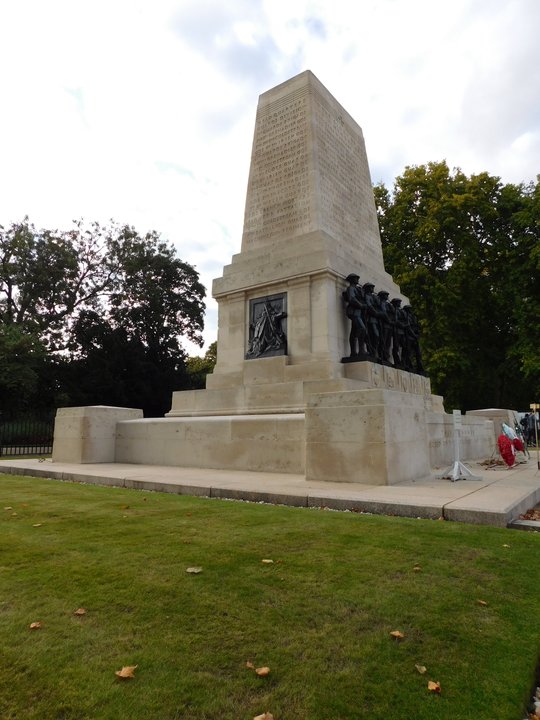
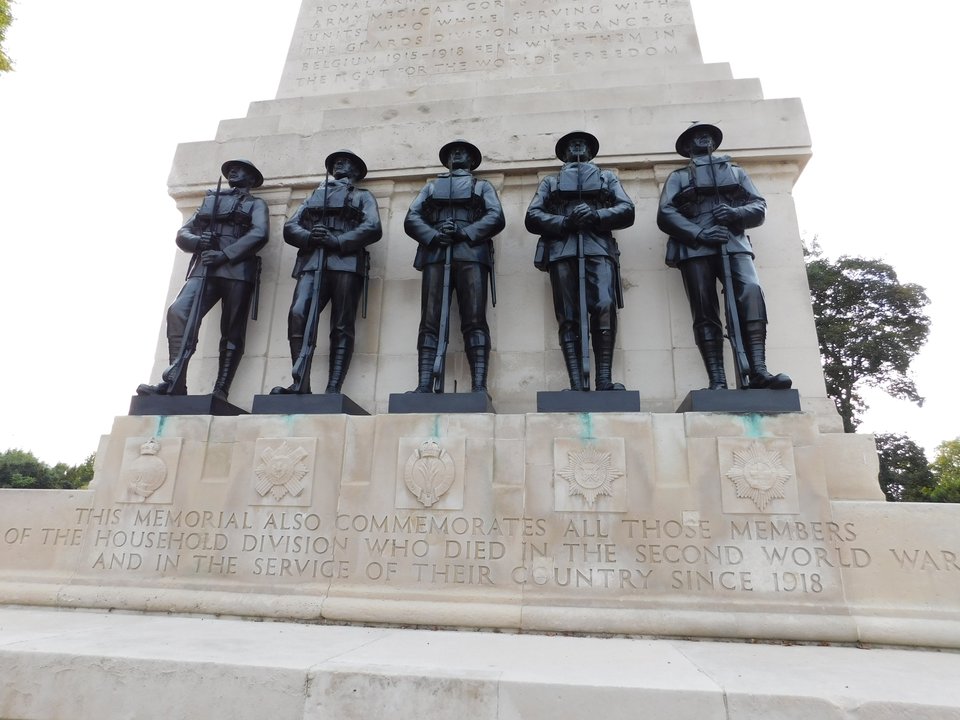
The Twentieth Century Society records that Bradshaw and the sculptor Gilbert Ledward won the competition for a Guards Division memorial in 1922; Ledward's own catalogue dates his bronzes for it 1922-1925. What they put up is a squat Portland stone pylon, 38 feet 6 inches to the top by Historic England's measure, with five over-lifesize bronze guardsmen standing easy along its base, one for each regiment of Foot Guards. Two published accounts say the bronze came from German guns melted down after the war. The models were serving soldiers, and the Imperial War Museum's London volunteers record that the Irish Guards figure is a composite: Guardsman Simon McCarthy lost patience partway through the sittings, and Lance Sergeant W. J. Kidd posed for the legs.
The face turned toward the park carries the division's order of battle in place of a name list: HEAD QUARTERS GUARDS DIVISION, then the three Guards Brigades and their battalions, ending 4TH BN COLDSTREAM GDS PIONEER BATTALION and 6TH BATTALION GUARDS MACHINE GUN REGIMENT. The east face carries the dedication, and it keeps two date ranges apart. The Foot Guards are commemorated for the GREAT WAR 1914-1918. The Household Cavalry, the gunners, engineers, service and medical corps and the other units attached to them are commemorated for FRANCE & BELGIUM 1915-1918 — the Guards Division itself was not formed until August 1915, and it was formed in France. The dedication ends FELL WITH THEM IN THE FIGHT FOR THE WORLD'S FREEDOM. Historic England's designation puts the Foot Guards dead at about 14,000.
Prince Arthur, Duke of Connaught, Senior Colonel of the Guards, unveiled it on 16 October 1926. Bradshaw was thirty-three, and had been the first secretary of the Royal Fine Art Commission since it was set up in 1924.
Bombs reached the bronzes in the next war and the registers do not tell it the same way. The Imperial War Museum records the damage to three figures as repaired; War Memorials Online reports that Ledward argued for leaving some of the punctures as honourable scars of war, and describes a hole still visible in one figure's left shoulder and cheek. Along the low wall beneath the five men a later line was cut: THIS MEMORIAL ALSO COMMEMORATES ALL THOSE MEMBERS OF THE HOUSEHOLD DIVISION WHO DIED IN THE SECOND WORLD WAR AND IN THE SERVICE OF THEIR COUNTRY SINCE 1918. Still no names. The memorial was listed in January 1970 and raised to Grade I in October 2014, and it stands open at the park edge with wreaths against the plinth.
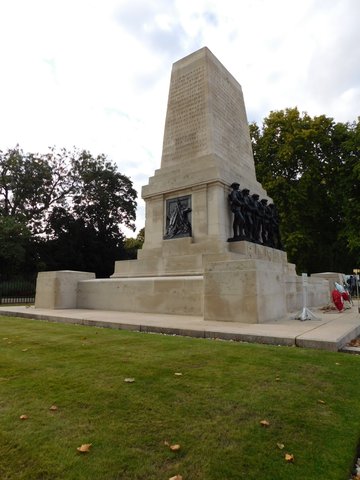
📸 Cover: the memorial from St James's Park, the face carrying the Guards Division's order of battle. Second image: the five bronze guardsmen, the regimental badges below them, and the Second World War line. Both by Paul the Archivist, 2017, CC BY-SA 4.0 via Wikimedia Commons.




 expand_more