


Dynastic History | Deir el-Medina — The Village That Cut the Royal Tombs, and Struck
Valley of the Kings, Global, Earth
Unreviewed contributionBy kevin · · updated · Report an issue


























Distribute Bounty
This will distribute the bounty equally among all qualifying memories. This action cannot be undone.
Cancel Bounty
Are you sure you want to cancel this bounty? The remaining amount will be refunded to your account.
Success!
Operation completed successfully.
Error
Something went wrong.
Dynastic History | Deir el-Medina — The Village That Cut the Royal Tombs, and Struck
kevin
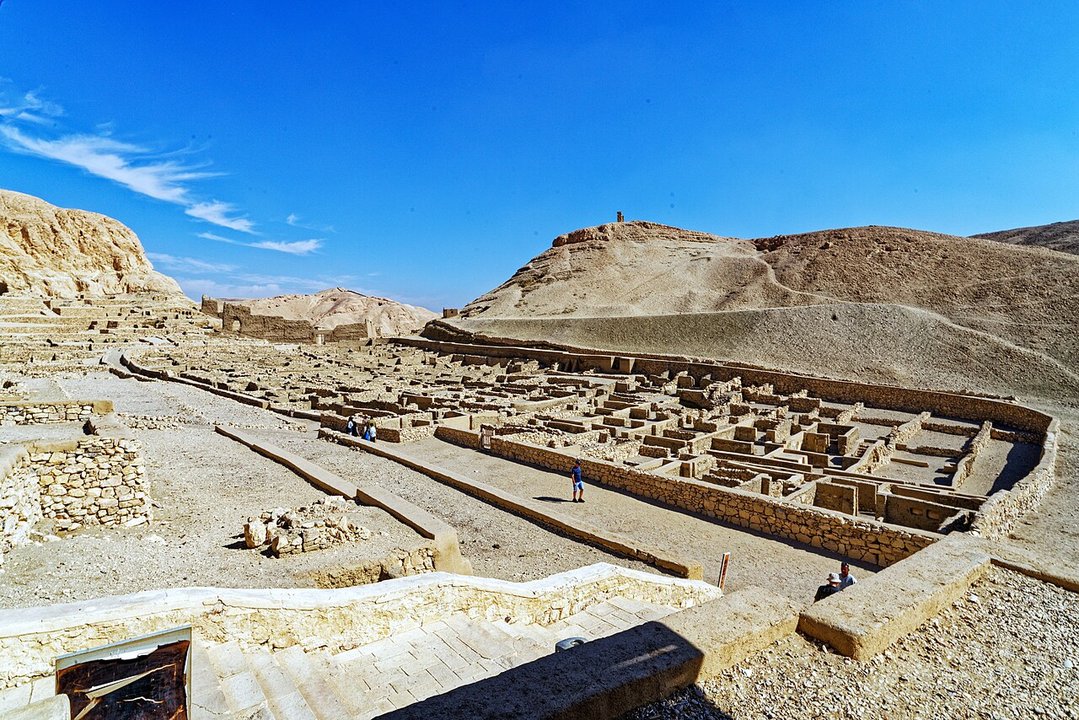
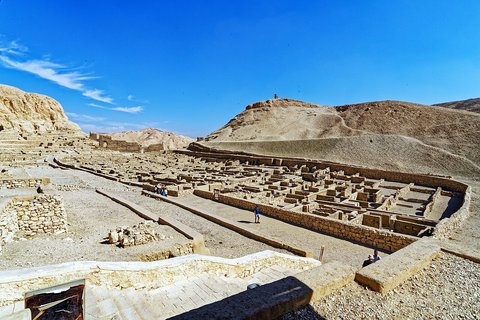
The state put its tomb-cutters in a walled village in a dry side-valley on the west bank at Thebes, out of sight of the river and with no water of its own. Officials called it Set Maat, the Place of Truth, and the men who lived there were Servants in the Place of Truth. At its fullest the walled settlement held about sixty-eight houses over some 5,600 square metres, with further dwellings on the slopes outside the wall. Everything — grain, water, fish, firewood, tools — was carried in from Thebes each month. That delivery was the wage.
Because the village was a payroll it generated paperwork, and because it sat in the desert the paperwork survived. Thousands of ostraca and papyri record the two gangs, left and right, their foremen and scribes, their absences, their loans and their disputes. The men were salaried state employees, drawing rations put by one published estimate at up to three times a field hand's rate. For once in a dynastic building programme, the people doing the cutting are legible.
It is also the record of what happened when the delivery failed. A papyrus written by the scribe Amunnakht, held by the Museo Egizio in Turin as Cat. 1880, dates the first stoppage to year 29 of Ramesses III, second month of Peret, day ten — conventionally around 1157 BCE, with the margin New Kingdom dates carry. The crews put down their tools, walked out, and sat down behind the memorial temple of Thutmose III. Their statement, in Paul Frandsen's translation, was that they were hungry, and that eighteen days of the month had already gone by.
Ernesto Schiaparelli excavated here from 1905, Bernard Bruyere from 1922. The village plan is walkable today on raised boards; its written record is scattered across museum collections in Turin, Cairo and Europe.
📸 Cover: The excavated street plan of Deir el-Medina, Holger Uwe Schmitt, CC BY-SA 4.0 via Wikimedia Commons
changes?
delete this memory?
We detected that you have a Blox in your crypto wallet! We will import the Blox into your account.
Click on done below to complete the import.
Welcome Back!
Sign in to preserve cherished moments
Don't have an account?
Welcome!!
Sign up and start preserving cherished moments
?
?




Choose your payment method
Buy with Metablox Credit
Do you want to mint Blox with Metablox Credit?
Which Crypto would you like to use?
Purchase Confirmed!
Your Blox is being minted on-chain and will appear in your profile shortly.
Log in or sign up to claim your Blox.
How many credits do you want to buy?
$100 USD = 1 Metablox Credit = 1 Blox.
Use Metablox Credit to mint any Blox you want on the map.
 expand_more