Landmark History | Kaaba — The 1880 Photograph That Recorded a Living Sanctuary
volume_up
Listen
directions
Directions
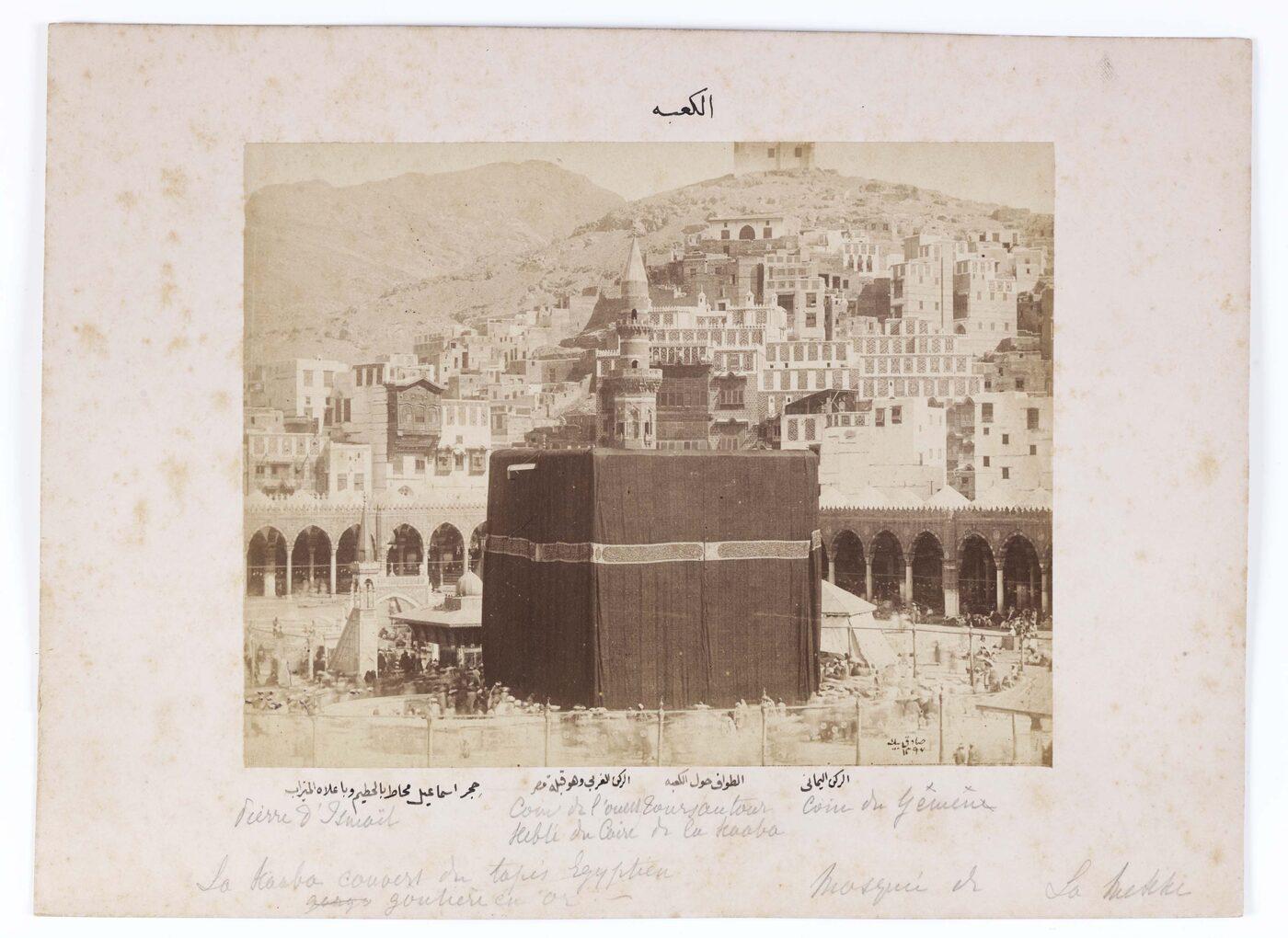
In 1297 AH, corresponding to 1880 CE, Muhammad Sadiq Bey positioned a glass-plate camera above the courtyard of al-Masjid al-Haram (المسجد الحرام) and recorded the Kaaba while pilgrims moved around it in tawaf.
The signed negative fixes both subject and year: the black-draped Kaaba stands inside the arcaded sanctuary, its rainwater spout is visible, and the worshippers’ circulation makes clear that this was not an empty architectural survey but an image of a living rite.
Mecca then lay in the Ottoman Hijaz, where an Ottoman governor and the Sharif of Mecca exercised overlapping authority; describing the scene simply as nineteenth-century Saudi Arabia would project a later state backward.
Sadiq was an Egyptian army engineer and surveyor as well as treasurer of the Egyptian Hajj caravan, so his access came through Muslim pilgrimage and administrative networks rather than through the later European travel market.
He had photographed on a surveying mission to Medina in 1861, but the Khalili Collections and Museum With No Frontiers date his major Meccan and Hajj photographs to 1880 and 1881 and identify him as the first person to photograph Mecca; because priority claims depend on surviving evidence, this signed Kaaba print is better understood as one of the earliest securely dated surviving photographic records of the city.
The camera did more than replace an artist’s drawing: a glass negative could produce albumen prints whose repeated circulation preserved the sanctuary’s spatial relationships, clothing, crowd scale, and ritual use with a degree of detail unavailable in earlier reproduced views.
In 1881, Sadiq presented a portfolio of Mecca, Medina, and pilgrimage-station photographs at the geographical gathering in Venice, received a gold medal, and issued views in publications that joined images to practical observations from his journeys.
Stephen Sheehi’s history of Arab photography places this work within Ottoman Egypt’s cartographic institutions and reform-era visual culture, reminding viewers that the camera’s claim to objective documentation also reflected the position and training of the official holding it.
Masjid al-Haram has since been repeatedly expanded, and the Ottoman-era courtyard surrounding the Kaaba in Sadiq’s frame does not survive in the same form, but the Kaaba remains at the center of tawaf and the photograph preserves how worship organized the sanctuary before twentieth- and twenty-first-century rebuilding.
Today the site remains an active sacred precinct rather than a sightseeing destination: official Saudi guidance restricts entry to Makkah to Muslims, and Hajj-period access is regulated, so the image offers documentary access without implying physical access for every viewer.
Photo: Muhammad Sadiq Bey, 1297 AH / 1880 CE, public domain, via the Khalili Collections and Wikimedia Commons.




























 expand_more